
Almost every diver has experienced it.
You’re enjoying the dive when you suddenly feel a small trickle of cold water running across your nose. You clear your mask, continue diving, and a minute later… it happens again.
A leaking mask is one of the most common frustrations underwater, especially for beginner divers. Fortunately, in most cases the mask itself isn’t the problem.
Before you spend money replacing perfectly good equipment, it’s worth understanding why dive masks leak and what you can do to fix the issue.
🟦 Quick Answer
Why does a dive mask leak? Most dive masks leak because they don’t seal properly against the face. The most common causes are an incorrect fit, an overtightened strap, hair trapped under the silicone skirt, facial hair or simple positioning mistakes. In most cases, the problem can be solved without buying a new mask.
The short answer: If you’re looking for the quick explanation, you’ve found it. If you’d like to understand why your mask leaks and how to stop it, keep reading.
The Most Common Reasons Your Mask Leaks
Not all leaks have the same cause.
Sometimes the solution takes only a few seconds, while other times it simply means choosing a mask that better matches your face.
Let’s look at the most common reasons.
1. Your Mask Doesn’t Fit Your Face
This is by far the number one cause of mask leaks.
Many new divers assume that if a mask is expensive or made by a well-known manufacturer, it will automatically fit them.
Unfortunately, that’s not how dive masks work.
Every diver has a different facial structure. A mask that seals perfectly on one diver may constantly leak on another.
A proper fit is far more important than the brand or price.
Before buying a mask:
- Place it gently against your face.
- Don’t use the strap.
- Inhale slightly through your nose.
If the mask stays in place for a few seconds without assistance, it’s usually a good sign that the skirt fits your face.
If it immediately falls away or obvious gaps appear around the edges, try another model.
2. You’re Tightening the Strap Too Much
This surprises many beginners.
When a mask leaks, the natural reaction is to tighten the strap.
In reality, this often makes the problem worse.
The silicone skirt is designed to seal naturally against your face. Pulling the mask too tightly can distort the skirt, creating small gaps where water can enter.
The strap should simply hold the mask in place.
The surrounding water pressure does the rest.
3. Hair Is Breaking the Seal
Even a few strands of hair can prevent the silicone skirt from sealing properly.
Long hair, loose bangs or even part of your hood trapped beneath the skirt can all create tiny leaks.
Before entering the water, take a few seconds to check:
- your hair is clear of the sealing edge
- your hood isn’t folded beneath the mask
- nothing is trapped under the silicone
It’s a simple habit that solves many leaking problems before they even begin.
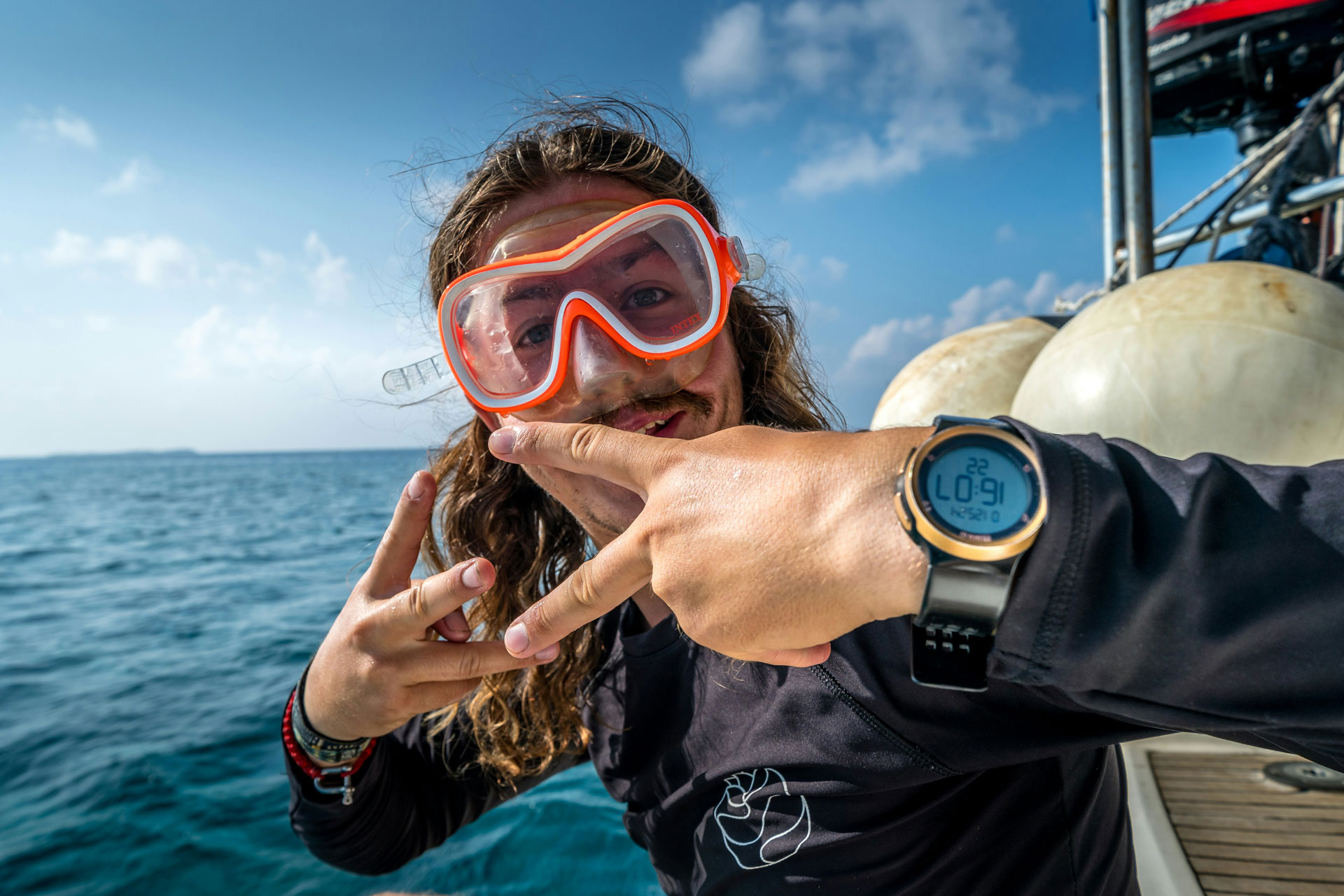
4. Mustaches and Beards
Facial hair is another common reason for small leaks around the upper lip.
Many divers with mustaches never experience problems, while others constantly find water entering near their nose.
If you have facial hair, you can try:
- trimming the hair directly beneath the nose
- applying a small amount of silicone grease or mustache wax (if compatible with your mask)
- trying a different mask model with a softer or longer silicone skirt
Sometimes a different mask design makes a remarkable difference.
5. You’re Smiling (Yes, Really!)
One of the most overlooked causes of mask leaks is… smiling.
Laughing, smiling or making exaggerated facial expressions changes the shape of your cheeks.
Even small muscle movements can temporarily lift part of the skirt away from your face, allowing a little water inside.
Don’t worry—this is perfectly normal and usually only results in a few drops of water.
In fact, many dive instructors joke that smiling is the most enjoyable reason for a leaking mask.
6. The Mask Isn’t Sitting Correctly
Sometimes the mask itself fits perfectly, but it isn’t positioned correctly.
If it’s sitting too high, too low or twisted slightly to one side, the silicone skirt won’t seal evenly.
Before descending, take a moment to press the mask gently into position and check that it feels comfortable all the way around your face.
A few seconds on the surface can save you from repeatedly clearing your mask throughout the dive.
7. The Silicone Has Aged
Quality dive masks can last for many years.
However, silicone isn’t indestructible.
Constant exposure to sunlight, poor storage or simply years of use can cause the skirt to become less flexible.
When that happens, the seal becomes less effective.
If your mask has served you faithfully for a decade, replacing it might finally be the right decision.
8. The Mask Is Simply the Wrong Model
Sometimes there isn’t anything “wrong” with your mask.
It’s simply the wrong shape for your face.
Manufacturers design masks for:
- narrow faces
- wider faces
- smaller faces
- larger faces
If you’ve tried every adjustment and the problem continues, trying another model is often the easiest solution.
How to Prevent Mask Leaks
A few simple habits make a huge difference.
Before every dive:
✔ Make sure the skirt lies flat against your face.
✔ Don’t overtighten the strap.
✔ Keep hair away from the sealing edge.
✔ Position your hood carefully.
✔ Test the fit before entering the water.
These checks take less than a minute but can save an entire dive.
Does a Leaking Mask Mean You Need a New One?
Usually not.
Most mask leaks are caused by small issues that can be corrected in seconds.
Only after you’ve ruled out fit, positioning, strap tension and facial hair should you consider replacing your mask.
A properly fitting mask should feel almost effortless underwater.
Once you find one that truly fits your face, you’ll probably keep it for many years.
Final Thoughts
A leaking mask is one of the most common problems divers face, but fortunately it’s also one of the easiest to solve.
Instead of assuming your equipment is faulty, spend a few minutes checking the simple causes we’ve covered above.
A small adjustment is often all it takes to transform an annoying dive into an enjoyable one.
After all, the less time you spend clearing your mask, the more time you spend enjoying the underwater world.