When divers think of Jacques Cousteau, one image almost always comes to mind.
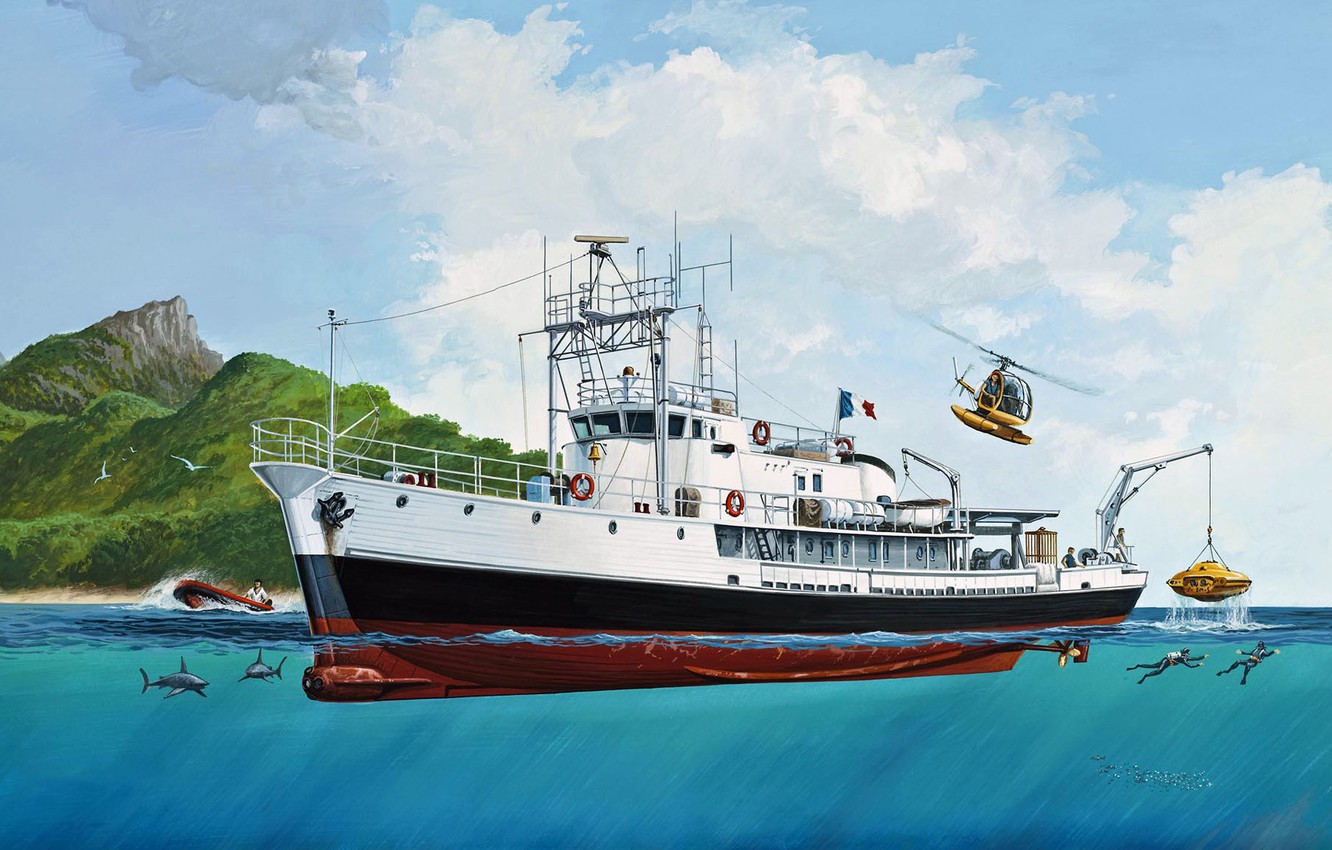
A white ship with a distinctive yellow stripe, quietly anchored in crystal-clear water while divers disappear beneath the surface.
That ship was Calypso.
More than just a research vessel, Calypso became a floating laboratory, a film studio, a scientific base and, perhaps most importantly, a symbol of humanity’s curiosity about the underwater world.
For nearly four decades, she carried Jacques Cousteau and his team across the world’s oceans, helping reveal marine life to millions of people who had never seen the sea from below the surface.
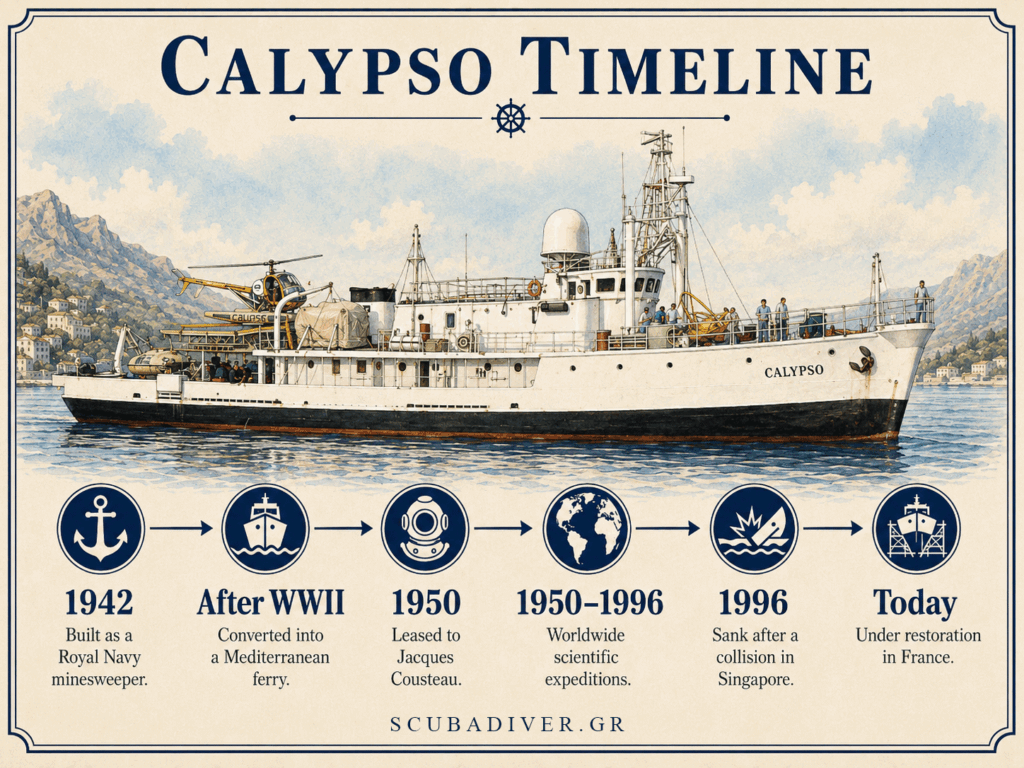
But long before becoming famous, Calypso had a very different life.
Quick Facts
- Name: Calypso
- Built: 1942
- Original Role: British Royal Navy minesweeper
- Acquired by Jacques Cousteau: 1950
- Main Mission: Oceanographic research and underwater filmmaking
- Famous For: Exploring the world’s oceans and starring in Cousteau’s documentaries
- Current Status: Under restoration in France
A Ship Built for War
Few people realize that Calypso was never designed as an exploration vessel.
She was built in the United States during World War II as a wooden-hulled minesweeper for the British Royal Navy.
Her job was dangerous: clearing naval mines from strategic waters.
After the war, she was converted into a small ferry serving the Mediterranean island of Malta, transporting passengers between islands.
At that point, nobody could have imagined that this modest vessel would one day become one of the most famous ships in maritime history.
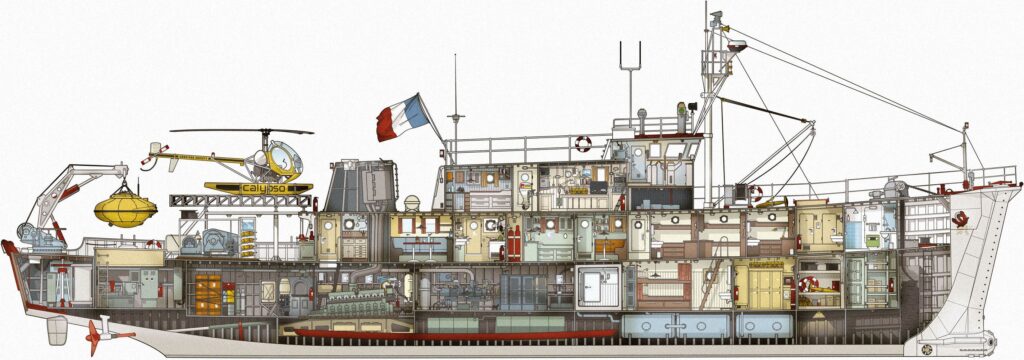
Cross Section, Calypso
The Beginning of a Legend
In 1950, Jacques Cousteau was looking for a ship that could support long scientific expeditions.
The vessel he found wasn’t luxurious.
It wasn’t particularly large.
But it was reliable, sturdy and could be modified exactly as he envisioned.
Thanks to financial support from Irish businessman Thomas Loel Guinness, Cousteau leased Calypso for a symbolic annual fee, reportedly just one franc.
That decision changed the history of underwater exploration.
A Floating Ocean Laboratory
Calypso underwent an extensive transformation.
She became far more than a ship.
Among her most remarkable features were:
- Fully equipped marine laboratories.
- Underwater observation chamber in the bow.
- Diving platform for easy water access.
- Cranes for launching submersibles.
- Onboard workshops.
- Film editing and production facilities.
Equipment for underwater photography and scientific sampling.
Every expedition allowed scientists, engineers, filmmakers and divers to work together under the same roof.
In many ways, Calypso became one of the world’s very first mobile oceanographic research centers.
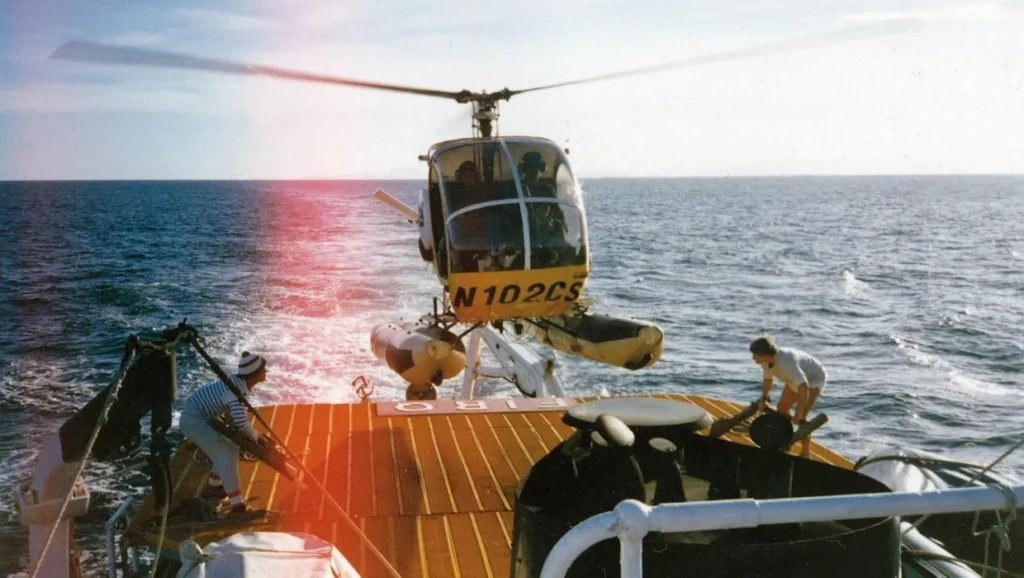
A helicopter (Enstrom F-28) equipped with floats landing on the wooden helicopter platform of the legendary research vessel Calypso during an expedition with Jacques Cousteau
Exploring the World’s Oceans
With Calypso as their home, Jacques Cousteau and his crew embarked on some of the most ambitious ocean expeditions ever attempted.
Over the following decades, they explored the Mediterranean, the Red Sea, the Indian Ocean, Antarctica, the Amazon River, the Great Barrier Reef and countless remote islands.
But these expeditions were about far more than collecting scientific data.
They introduced millions of people to an underwater world they had never imagined.
For many viewers, Cousteau’s documentaries were their very first glimpse beneath the surface of the ocean.
Long before YouTube, action cameras or underwater drones, Calypso was already bringing the sea into living rooms around the world.
More Than a Ship
Calypso wasn’t simply a means of transportation.
She became a floating innovation hub where engineers, filmmakers, divers and marine scientists worked side by side.
Many underwater filming techniques that are now considered standard were developed or refined aboard Calypso.
The crew constantly experimented with new cameras, lighting systems, diving equipment and underwater vehicles, often designing custom solutions for challenges that had never been encountered before.
Every expedition pushed the limits of what was technically possible.
Inspiring a Generation of Divers
It’s difficult to measure Calypso’s true impact.
Her greatest contribution wasn’t a scientific discovery or a technological invention.
It was inspiration.
For thousands of divers, marine biologists and underwater photographers, Calypso represented adventure, curiosity and respect for the ocean.
Many of today’s professionals openly admit that their passion for the underwater world began while watching Cousteau’s documentaries as children.
In that sense, Calypso became much more than a research vessel.
She became an icon.
The Accident That Shocked the Diving Community
After decades of exploration, Calypso’s remarkable journey came to an unexpected halt.
In January 1996, while docked in Singapore, the vessel was accidentally struck by a barge.
The collision tore a large hole in her hull and Calypso sank in the harbor.
Although she was later raised from the seabed, the damage marked the beginning of a long and complicated chapter.
For years, legal disputes, ownership issues and restoration challenges delayed her return.
Many feared the legendary vessel would never sail again.
A New Chapter
Today, Calypso is undergoing restoration in France.
The goal is not simply to preserve an old ship but to protect an important piece of diving history.
Once completed, the restoration aims to ensure that future generations can experience the vessel that helped transform underwater exploration forever.
Whether she sails again or serves as a museum, her legacy has already been secured.
Final Thoughts
Few ships have changed the way humanity understands the sea.
Calypso did.
She wasn’t the fastest vessel, the largest research ship or the most technologically advanced of her time.
Yet she became the face of underwater exploration because of the people aboard her and the stories they shared with the world.
Every modern diver has, in one way or another, benefited from the curiosity that left Calypso’s deck.
Her voyages expanded not only our knowledge of the oceans but also our desire to protect them.
More than seventy years after Jacques Cousteau first stepped aboard, Calypso remains one of the greatest symbols of exploration ever to sail the seas.
Did You Know?
The name Calypso comes from the sea nymph in Greek mythology who kept Odysseus on the island of Ogygia for seven years. It was a fitting name for a ship that would spend decades exploring the world’s oceans.
The Cousteau Legacy
This article is part of The Cousteau Legacy, an ongoing Scubadiver series exploring the people, inventions and expeditions that transformed underwater exploration.
Jacques Cousteau: The Man Who Made the Ocean Visible
The Invention of the Aqualung: How Diving Became Truly Free
Calypso: The Ship That Changed Underwater Exploration
Conshelf: When Humans Tried Living Underwater