For more than 70 years, the Titanic lived somewhere between history and myth.
Everyone knew the story.
The largest and most famous ocean liner of its time had struck an iceberg on its maiden voyage and disappeared into the North Atlantic on April 15, 1912.
But the wreck itself remained unseen.
Its exact location was uncertain. Its condition was unknown. And for decades, the Titanic existed mostly through survivor accounts, newspaper headlines, photographs and imagination.
Then, on September 1, 1985, the deep sea finally revealed the ship.
More than 3,800 metres beneath the surface of the North Atlantic, a camera system called Argo began transmitting images from the ocean floor. First came scattered debris. Then came one of the unmistakable boilers of the Titanic.
The search was over.
The legend had become a real place.
Quick Answer
The wreck of RMS Titanic was discovered on September 1, 1985, by a joint French-American expedition led by Robert Ballard of Woods Hole Oceanographic Institution and Jean-Louis Michel of IFREMER.
The team used advanced deep-sea technology, including the towed imaging system Argo, to search the seafloor at a depth of about 3,800 metres.
The discovery was a turning point in deep-sea exploration, underwater archaeology and public understanding of historic shipwrecks.
A Ship Lost to the Deep
RMS Titanic sank in the early hours of April 15, 1912, after striking an iceberg during its maiden voyage from Southampton to New York.
More than 1,500 people died.
The disaster shocked the world and changed maritime safety forever. But while the human story of Titanic became famous almost immediately, the wreck itself remained out of reach.
The North Atlantic was vast.
The depth was extreme.
The technology needed to search such an area simply did not exist for much of the 20th century.
Finding Titanic was not just a matter of knowing where to look.
It required the ability to see in total darkness, under crushing pressure, across a huge and unforgiving seafloor.
Key Facts
Date discovered: September 1, 1985
Location: North Atlantic Ocean
Depth: About 3,800 metres / 12,500 feet
Expedition: Joint WHOI–IFREMER expedition
Key figures: Robert Ballard and Jean-Louis Michel
Main technology: Argo towed imaging system
First clear identification: One of Titanic’s boilers
Why it mattered: It changed deep-sea exploration and transformed Titanic from a lost legend into a documented wreck site
The Search That Found Titanic
The 1985 search was not a simple treasure hunt.
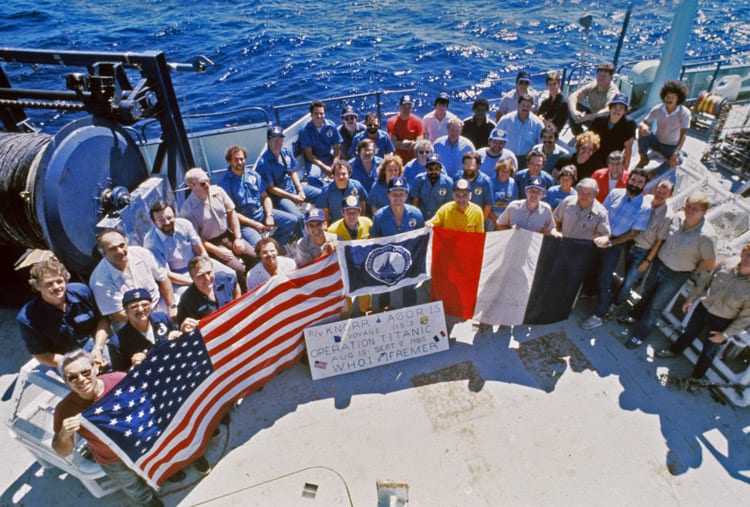
It was a scientific and technological expedition involving two major oceanographic institutions: Woods Hole Oceanographic Institution in the United States and IFREMER in France.
The French team first searched large areas of the seabed using side-scan sonar from the research vessel Le Suroit. Then the American team continued the search from the research vessel Knorr, using Argo, a deep-towed camera and sonar system developed by WHOI.
Instead of looking only for the ship’s hull, the team searched for a debris field.
That approach was crucial.
When a large ship breaks apart or sinks violently, it may leave a trail of objects across the seabed: machinery, coal, personal items, pieces of structure and equipment.
The Titanic was no exception.
By following debris, the team could find the wreck even if the main sections of the ship were not immediately visible.
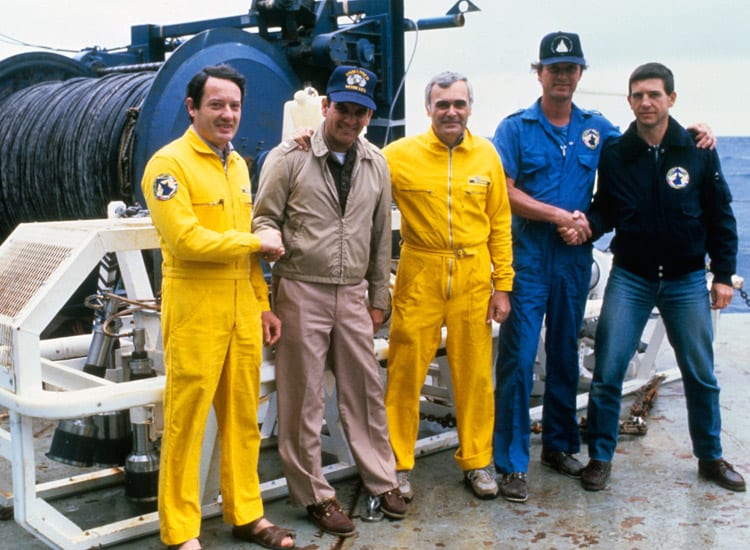
The discovery team leaders from left to right Jean-Louis Michel (IFREMER), Lt. George Ray (US Navy), Jean Jerry (IFREMER), Bob Ballard and Bernard Pillaud (IFREMER). (© National Geographic)
Argo: The Machine That Saw the Titanic
Argo was one of the stars of the discovery.
It was not a submarine carrying people. It was a deep-towed imaging system, designed to survive enormous pressure and send back images from the darkness of the deep ocean.
To modern eyes, this may sound normal. Today we are used to remotely operated vehicles, live deep-sea footage and high-resolution underwater mapping.
But in 1985, this technology was still transforming what was possible.
Argo allowed scientists to search wide areas of the ocean floor visually, without needing a human-occupied submersible to make every pass.
It was patient, systematic and perfectly suited to the task.
In the early hours of September 1, the images changed history.
A boiler appeared on the monitors.
It was one of the unmistakable signs that the team had found Titanic.
The Cold War Story Behind the Discovery
The discovery of Titanic also had a surprising hidden chapter.
Robert Ballard’s search was connected to a classified U.S. Navy mission. Before looking for Titanic, Ballard had been involved in work related to the wrecks of two lost American nuclear submarines: USS Thresher and USS Scorpion.
The Navy was interested in deep-sea technology and in understanding what had happened to those submarines.
Ballard was interested in Titanic.
The result was an unusual overlap between Cold War naval priorities and one of the most famous shipwreck searches in history.
After the Navy-related work was completed, the remaining time at sea was used to search for Titanic.
That detail gives the discovery an almost cinematic quality.
One of the most famous wrecks in the world was found not by luck, but through a combination of military secrecy, scientific ambition and new deep-ocean technology.
What They Found
The Titanic was not sitting perfectly intact on the seabed.
The wreck was broken.
The bow and stern lay separated. Debris was scattered across the ocean floor. The ship had been transformed by impact, pressure, corrosion and time.
But it was unmistakably Titanic.
The discovery changed the way people imagined the disaster.
Until then, Titanic was mainly remembered through dramatic surface images: the iceberg, the lifeboats, the sinking ship, the people left behind.
After 1985, the story gained a new dimension.
There was now a real underwater site.
A place.
A grave.
A historical archive in the deep sea.
From Shipwreck to Underwater Heritage
The discovery raised difficult questions almost immediately.
Should objects be recovered?
Should the wreck be left untouched?
Who has the right to visit, study or film a site connected to the deaths of more than 1,500 people?
For divers and underwater explorers, Titanic became one of the clearest examples of the difference between a wreck and a heritage site.
A wreck is not only metal.
It can be evidence.
It can be memory.
It can be a grave.
The Titanic lies far beyond the reach of ordinary scuba diving, but the ethical questions around it apply to many wrecks that divers do visit.
Look, document and respect.
But never forget what the site represents.
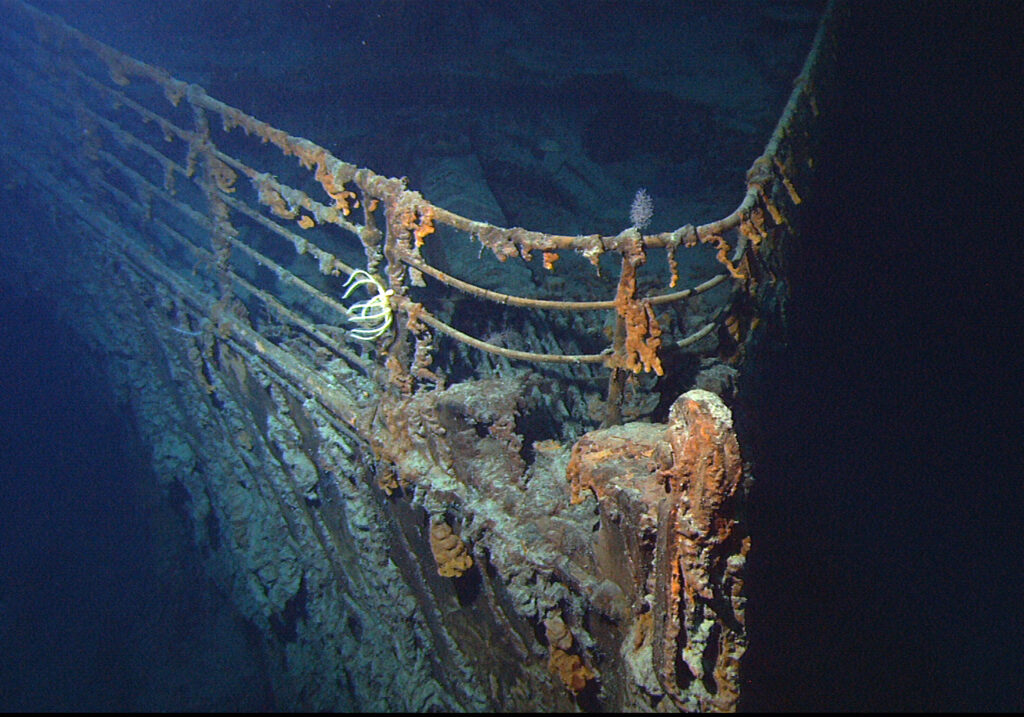
The Titanic’s bow in June 2004. By Courtesy of NOAA/Institute for Exploration/University of Rhode Island (NOAA/IFE/URI).
Why the Discovery Still Matters
The discovery of Titanic was not only important because the ship was famous.
It proved that humans could search, image and study the deep ocean with a new level of precision.
It helped push forward the use of remotely operated and towed deep-sea systems.
It brought underwater archaeology into public imagination.
And it reminded the world that the deep sea is not empty.
It contains stories, machines, ecosystems, disasters and traces of human history waiting in darkness.
The Titanic had been lost for 73 years.
When it was found, it did not end the story.
It changed the story.
The ship was no longer only a tragedy from 1912.
It became a deep-sea landmark, a technological milestone and one of the most powerful reminders that the ocean keeps history in ways we are still learning to understand.
The Day the Deep Sea Revealed a Legend
On September 1, 1985, the Titanic returned to the world.
Not as a ship.
Not as a survivor’s memory.
But as a wreck, resting in silence more than 3,800 metres below the North Atlantic.
Its discovery marked a turning point in ocean exploration and in the way we think about historic shipwrecks.
Some wrecks are found.
Some are studied.
Some become symbols.
Titanic became all three.
And in the darkness of the deep sea, a legend became visible again.