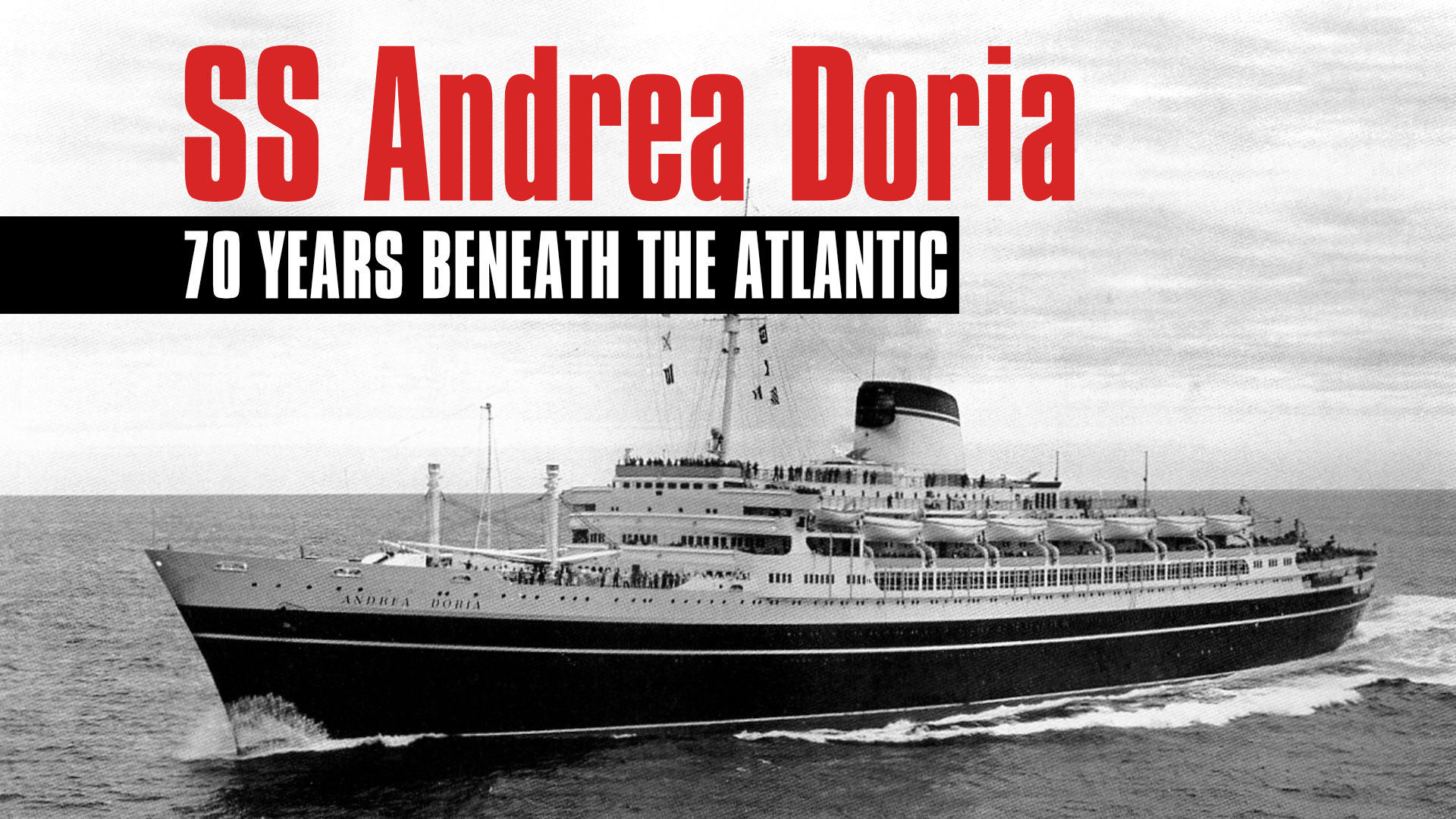
Seventy years ago, the SS Andrea Doria disappeared beneath the Atlantic Ocean.
Once celebrated as a symbol of post-war Italian elegance, the luxury liner became the centre of one of the most famous maritime disasters of the 20th century.
But its story did not end when it sank on July 26, 1956.
Resting in approximately 75 metres of water off Nantucket, the Andrea Doria became one of the world’s most legendary—and dangerous—technical diving sites.
SS Andrea Doria — Quick Facts
- Collision: July 25, 1956
- Sinking: July 26, 1956
- Collision partner: MS Stockholm
- Lives lost: 51 across both ships
- People rescued from Andrea Doria: 1,660
- Wreck depth: approximately 75 metres / 250 feet
- Location: Atlantic Ocean, south of Nantucket
Italy’s Floating Showcase
The Andrea Doria was named after the 16th-century Genoese admiral and statesman of the same name.
Built by the Ansaldo shipyards in Genoa, the liner entered service in January 1953. Measuring approximately 212 metres in length, it was the largest and most prestigious passenger ship in the Italian fleet.
Its interiors were designed to showcase Italian art, craftsmanship and post-war confidence. The ship featured luxurious lounges, valuable artworks and three outdoor swimming pools—one for each passenger class.
Andrea Doria was not the fastest transatlantic liner of its era, but speed was not its main attraction.
It represented style, comfort and modern Italian design.
The ship was also considered highly advanced. It had radar, a double hull and 11 watertight compartments. Its designers believed that any two compartments could flood without placing the ship in immediate danger.
On its 51st westbound crossing, Andrea Doria was carrying passengers from Genoa toward New York.
It would never reach its destination.
A Collision in the Fog
On the night of July 25, 1956, Andrea Doria was approaching the coast of Massachusetts through areas of dense and intermittent fog.
Travelling in the opposite direction was the Swedish passenger liner MS Stockholm, which had departed New York for Europe.
Both ships detected each other on radar, yet their crews interpreted the developing situation differently. By the time the vessels became visible through the fog, they were dangerously close.
Shortly after 11:00 p.m., Stockholm’s reinforced bow struck Andrea Doria’s starboard side at a near-right angle.
The impact tore deeply into the Italian liner, cutting through several passenger decks and killing people inside their cabins. Five crew members also died in Stockholm’s damaged bow.
Andrea Doria immediately began taking on water and developed a severe list to starboard.
The angle quickly made the lifeboats on the port side impossible to launch. Although the ship technically carried enough lifeboat capacity for everyone aboard, only around half of it was now usable.
What could have become a disaster on the scale of the Titanic instead developed into one of the most remarkable rescue operations in maritime history.
The Rescue of 1,660 People
Andrea Doria transmitted distress calls, and several ships changed course to assist.
The damaged Stockholm remained at the scene and launched its own lifeboats. The cargo ships Cape Ann and Private William H. Thomas, the transport ship Edward H. Allen and other vessels also joined the operation.
The most important arrival was the French ocean liner Île de France.
Its captain, Raoul de Beaudéan, had already passed the Andrea Doria earlier that evening but turned his ship around after learning how serious the situation had become.
When Île de France arrived, it illuminated the darkness with its exterior lights and positioned itself near the stricken liner. Its lifeboats repeatedly crossed the water between the two ships, carrying hundreds of survivors to safety.
In total, 1,660 passengers and crew were rescued from Andrea Doria. The calm weather, modern radio communications and rapid response of nearby vessels prevented a far greater loss of life. South Street Seaport Museum records 46 deaths aboard Andrea Doria, while five crew members died aboard Stockholm.
Among the extraordinary survival stories was that of 14-year-old Linda Morgan.
The force of the collision reportedly threw her from her cabin aboard Andrea Doria onto Stockholm’s damaged bow. She survived and became known in the press as the “miracle girl.”
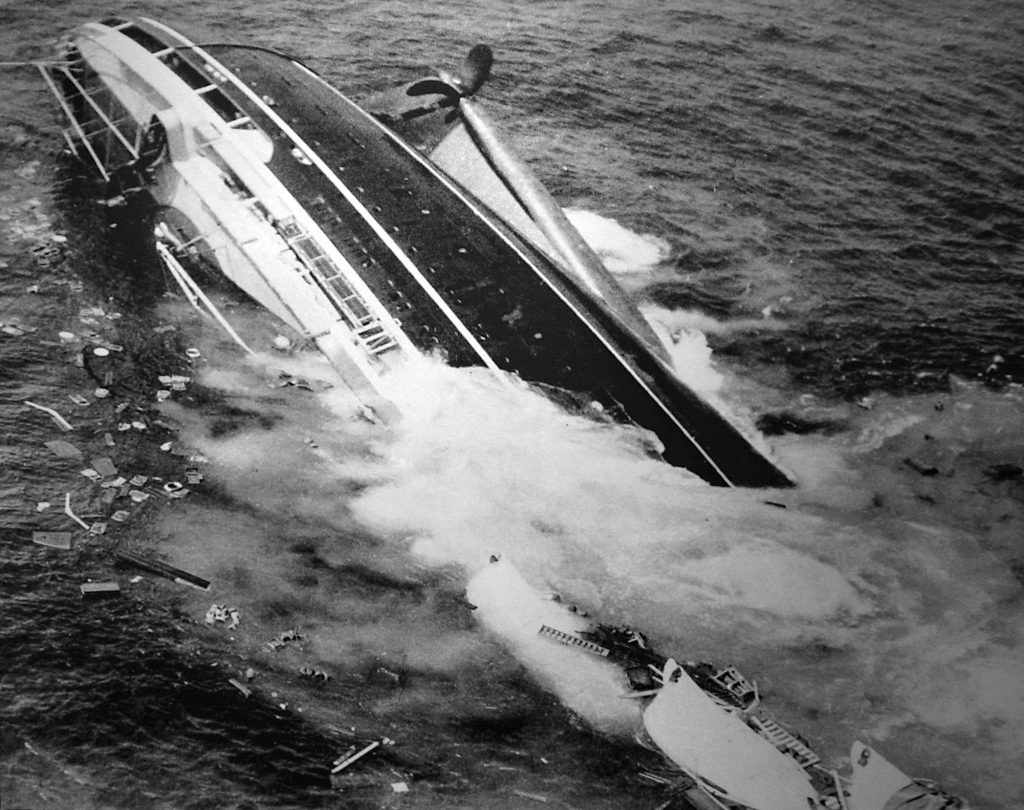
Harry A. Trask’s Pulitzer Prize-winning photo of Andrea Doria minutes before she sank
The Final Hours
Andrea Doria remained afloat throughout the night, but its list continued to increase.
By morning, the passengers and most of the crew had been evacuated. Captain Piero Calamai and the remaining officers were eventually forced to abandon the ship.
At approximately 10:09 a.m. on July 26, 1956, Andrea Doria rolled onto its starboard side and disappeared beneath the Atlantic.
Photographs taken from the air captured its final moments as the stern rose and the liner slipped below the surface. One of those images, taken by Boston Traveler photographer Harry A. Trask, later received a Pulitzer Prize.
The legal proceedings that followed never produced a definitive public verdict on responsibility. The shipping companies reached an out-of-court settlement, leaving the exact allocation of blame the subject of debate for decades.
Radar interpretation, speed in fog, course alterations and communication failures all became part of the discussion surrounding the collision.
From Ocean Liner to Legendary Wreck
Andrea Doria came to rest on its starboard side approximately 50 miles south of Nantucket.
The seabed lies at roughly 75 metres / 250 feet, well beyond normal recreational diving limits. The wreck’s upper sections are shallower, but still deep enough to require advanced technical-diving procedures.
Its location was never a mystery.
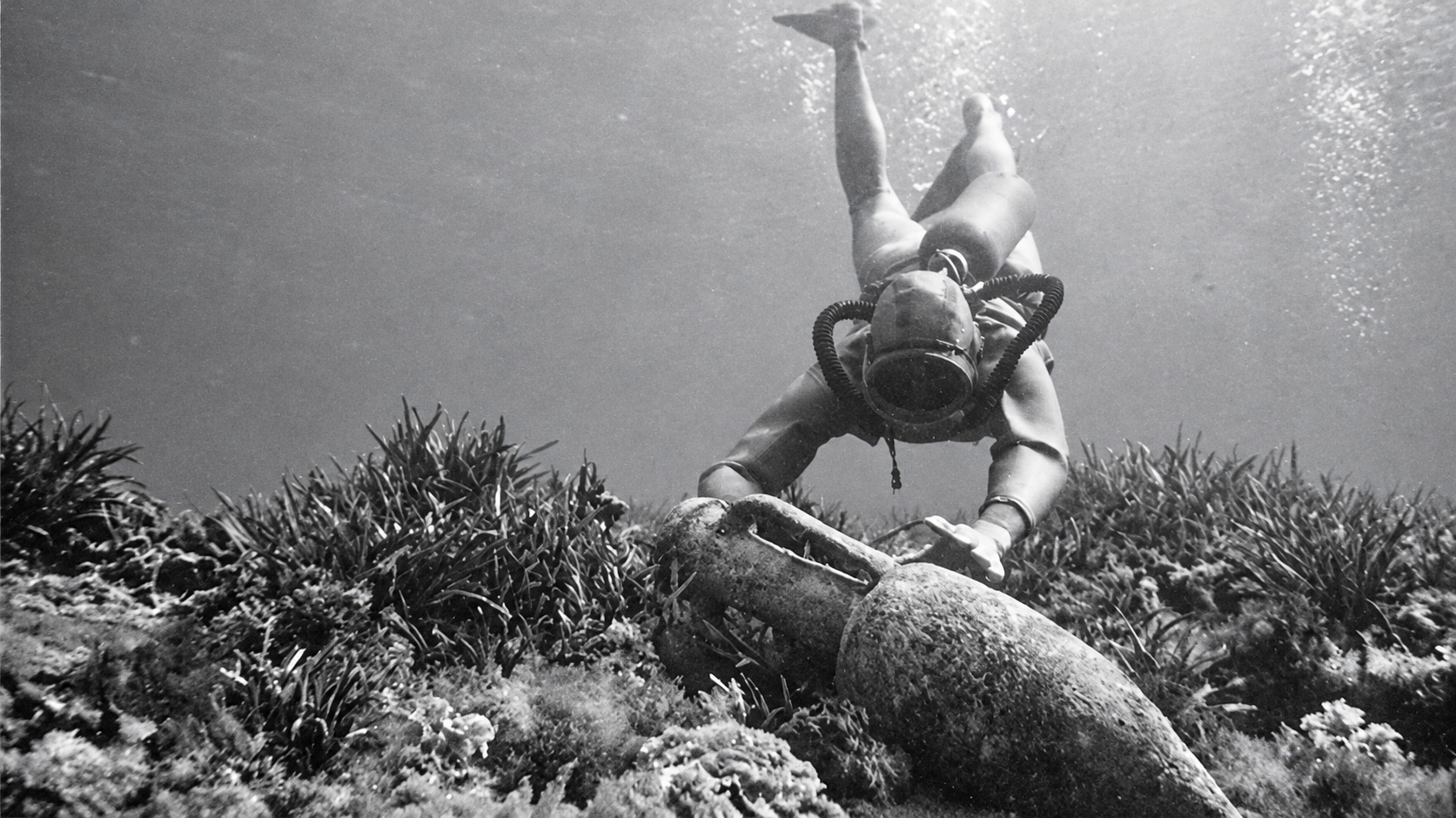
Underwater photographer Peter Gimbel reached the wreck shortly after the sinking, beginning a relationship with Andrea Doria that would continue for decades. Early photographs revealed an enormous ocean liner resting almost intact in the darkness.
The wreck soon attracted explorers, photographers and artifact hunters.
Divers recovered china, artwork, bells, navigation equipment and parts of the ship’s interior. Gimbel later led the complex recovery of one of Andrea Doria’s safes, which was opened during a televised event in 1984.
The safe contained little of the treasure many viewers had imagined.
By then, however, Andrea Doria had already become a treasure in its own right.
The “Mount Everest of Wreck Diving”
Andrea Doria is often called the “Mount Everest of wreck diving.”
The nickname reflects far more than its depth.
The wreck lies far offshore in the North Atlantic, where divers can encounter cold water, strong currents, rough seas and rapidly changing visibility. Reaching the wreck requires a long boat journey, and suitable weather windows can be limited.
At depth, divers must manage mixed breathing gases, accelerated air consumption, narcosis, decompression obligations and limited bottom time.
Fishing nets and lines have also become entangled around parts of the structure, creating an additional risk.
Penetration is particularly dangerous. Andrea Doria is not a stable museum resting on the seabed—it is a large steel structure that has been deteriorating for 70 years.
More than a dozen divers have died during expeditions to the wreck. The precise number varies depending on whether deaths aboard expedition vessels and after dives are included, but its reputation as an unforgiving site is well established.
This is not a wreck for recreational divers or inexperienced technical teams.
A Ship Slowly Disappearing
The Andrea Doria seen by today’s divers is very different from the almost-intact liner photographed in the 1950s and 1960s.
Decades of corrosion, currents and structural collapse have transformed the wreck.
Upper decks have fallen away, sections of the hull have fractured and many once-recognisable features no longer exist. Parts of the bow have separated, while a large debris field now surrounds the main structure.
New areas may temporarily become exposed as other sections collapse, but this does not make the wreck safer. Every change can create unstable metal, new entanglement hazards and spaces that bear little resemblance to the original deck plans.
Andrea Doria is gradually returning to the Atlantic seabed.
Divers are not simply exploring a shipwreck. They are witnessing its slow disappearance.
Seventy Years Beneath the Atlantic
The 70th anniversary of the sinking is an opportunity to remember Andrea Doria as more than a famous technical dive.
It is the story of a collision that killed 51 people across two ships.
It is also the story of 1,660 people rescued through cooperation between crews, passengers and vessels from several nations.
For divers, the wreck represents ambition, exploration and the limits of human ability. It has helped shape the culture of deep wreck diving in the northeastern United States, while repeatedly demonstrating how quickly experience and preparation can be overwhelmed.
Seventy years after Andrea Doria slipped beneath the surface, the Atlantic continues to reshape what remains.
The liner that once embodied Italian elegance now survives as fractured steel, scattered artifacts and memory.
Its story, however, remains very much alive.