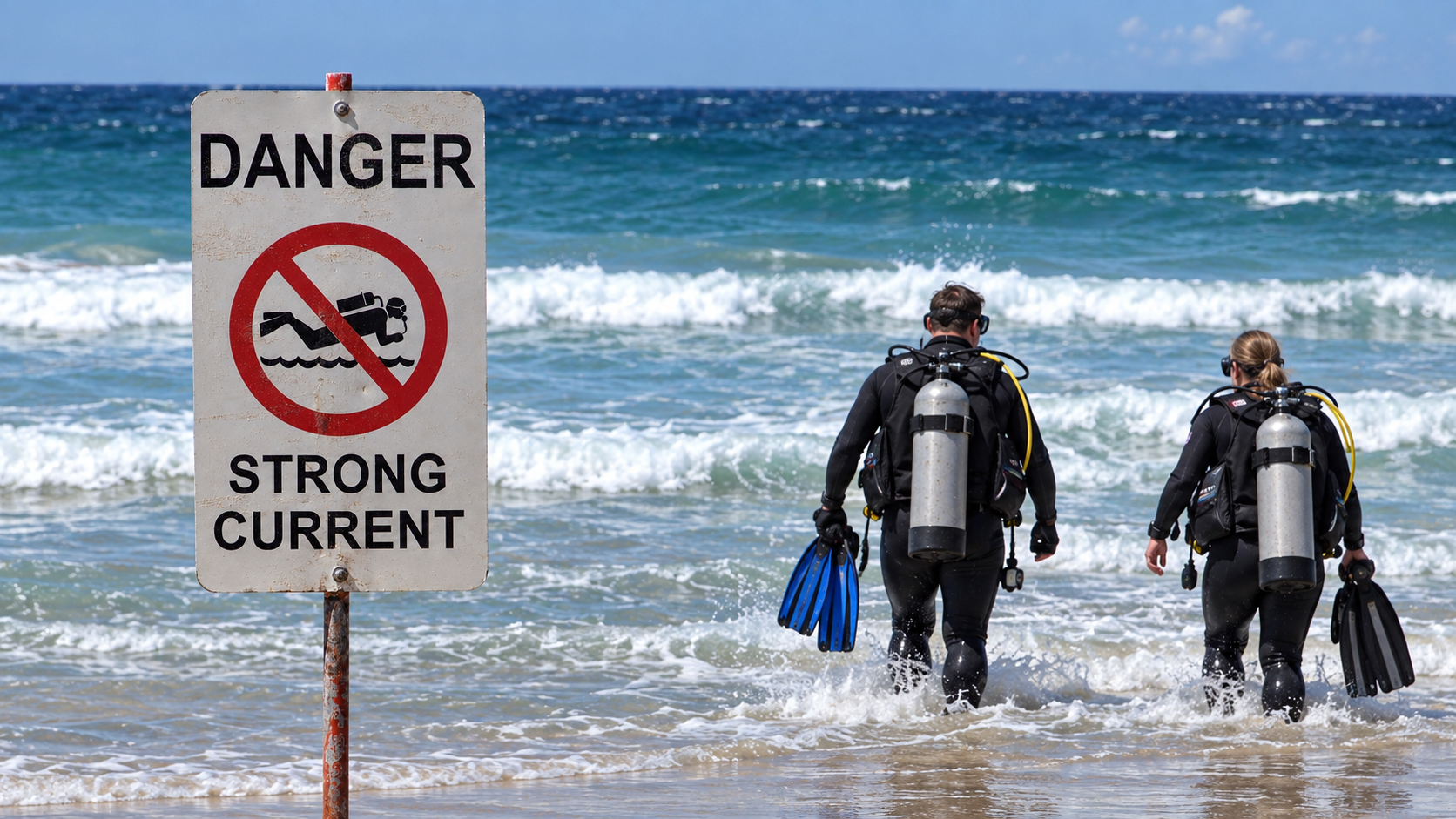
Strong currents while scuba diving can rapidly separate buddies, increase air consumption and carry a diver away from the planned route—or even towards greater depth.
However, not every current requires the same response. A planned drift dive, an unexpected horizontal current and a vertical downcurrent present very different challenges.
The safest reaction depends on the type of current, the dive site, the conditions and the procedures agreed upon during the briefing.
Quick Answer
If you encounter a strong current while scuba diving, stay close to your buddy, avoid exhausting yourself by fighting directly against the flow and signal the dive leader if one is present.
Follow the site-specific dive plan. Seek shelter behind suitable underwater features if this can be done safely, monitor your depth and remaining air, and end the dive if the conditions exceed your ability or the agreed plan.
If a vertical current begins carrying you deeper or towards the surface, prioritise regaining depth control and moving out of the affected area. Avoid making large, sudden buoyancy changes that could lead to an uncontrolled ascent once you leave the current.
STRONG CURRENTS: QUICK FACTS
Main risks: Separation, exhaustion, increased air consumption and loss of depth control
First response: Stay calm, signal your buddy and identify the direction of the current
Avoid: Prolonged hard swimming directly against the flow
Monitor: Depth, ascent rate, remaining air and proximity to your buddy
Essential equipment: DSMB or SMB, reel or spool, whistle and another surface signalling device
Best prevention: Local knowledge, proper briefing, suitable training and conservative planning
Are All Underwater Currents the Same?
No. Understanding the type of current is essential before deciding how to respond.
A horizontal current moves divers across the dive site. On a planned drift dive, this movement is expected and the dive route, group procedures and boat pickup should be organised around it.
An unexpected horizontal current may push divers away from the exit point, separate a group or make returning to the boat or shore difficult.
Vertical currents are different. A downcurrent can carry a diver deeper, while an upcurrent can produce an unexpected ascent. These currents may occur near walls, reefs, channels, corners and areas where moving water interacts with underwater topography.
Because currents behave differently at every dive site, advice from an experienced local dive operator is more valuable than relying on a single general rule.
What Should You Do in a Strong Horizontal Current?
Stay close to your buddy and communicate immediately. If the dive includes a guide, follow the signals and procedures explained during the briefing.
Avoid continuously swimming directly against a current that is stronger than your ability. Hard finning increases physical effort, breathing rate and air consumption and may produce very little forward movement.
If conditions allow, move closer to the bottom or seek shelter behind a reef formation, wreck section or another solid feature, where the current may be weaker.
Do not enter an overhead environment, touch living coral or place yourself at risk of entanglement simply to escape the flow.
It may sometimes be possible to move across the current towards a weaker area, but this is not a universal rule. The safest direction depends on the local topography, current pattern, planned exit and instructions provided during the briefing.
DO NOT APPLY THE RIP-CURRENT RULE AUTOMATICALLY
Advice to “swim perpendicular to the current” is commonly given to swimmers caught in surface rip currents.
It should not be treated as a universal solution for scuba divers. Underwater currents may behave differently because of depth, reefs, walls, channels and changing tides.
Follow the site-specific plan and prioritise buddy contact, depth control and air management.
Should You Fight Against the Current?
Usually, sustained hard swimming directly against a powerful current should be avoided.
A diver who becomes exhausted may begin breathing rapidly, consume air much faster and experience greater difficulty controlling buoyancy or responding to another problem.
For a dive that is not intended to be a drift dive, the route should normally be planned so the more demanding section is completed against the current at the beginning, with the return assisted by the flow.
If the current becomes significantly stronger than expected, attempting to force the original plan may be unsafe. Ending the dive from a suitable location can be a better decision than continuing to fight for a particular exit point.
What Should You Do in a Downcurrent?
A downcurrent is a vertical flow that carries a diver towards greater depth. The immediate priorities are to stay calm, monitor depth and remain in contact with your buddy if possible.
Try to move horizontally out of the affected area while maintaining control. Depending on the site, the current may weaken only a short distance away.
Near a wall or reef, a solid, safe handhold may provide temporary stability in an emergency, but avoid living coral, unstable surfaces and areas that create an entanglement or entrapment risk.
Continue equalising as depth increases and monitor your remaining air. A rapid, unexpected descent can significantly increase breathing-gas consumption.
Avoid immediately filling the BCD in an attempt to overpower the current. A small, controlled adjustment may sometimes be necessary, but excessive positive buoyancy can become dangerous. When the current weakens, the expanding air in the BCD or drysuit may produce a rapid, uncontrolled ascent.
If you add air, be prepared to vent it promptly as you regain depth.
Dropping weights is an emergency response rather than the first solution. It may create an uncontrollable ascent after the diver leaves the downcurrent.
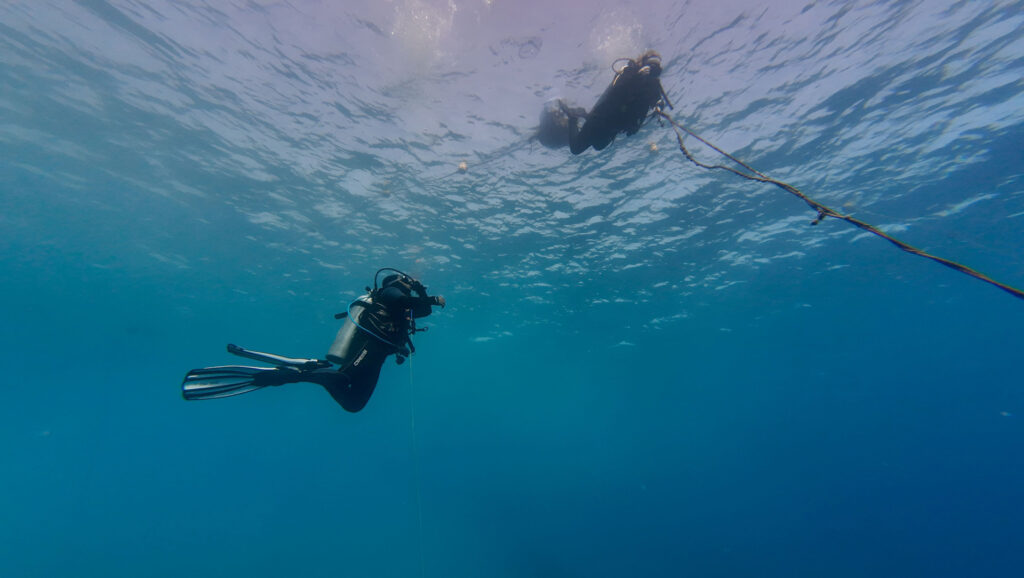
Staying close to your buddy is especially important when diving in moving water.
What Should You Do in an Upcurrent?
An upcurrent can carry a diver towards shallower water faster than intended.
Vent air from the BCD—and from the drysuit if one is being used—to prevent expanding air from accelerating the ascent. Never hold your breath.
Attempt to move horizontally out of the strongest flow while monitoring your depth and ascent rate. If a safe, solid handhold is available, it may help you regain temporary control.
Once clear of the current, stabilise your buoyancy and continue the ascent at a controlled rate. Follow any decompression obligations shown by your dive computer and complete a safety stop if conditions allow.
If an uncontrolled ascent occurs, end the dive and monitor for symptoms. Breathing difficulty, chest pain, confusion, weakness, unusual fatigue or other neurological symptoms require urgent medical assessment.
What If You Become Separated from the Group?
Remain with your buddy. Two divers separated from the main group are in a safer position than two individual divers searching independently.
Follow the separation procedure agreed upon during the briefing. This commonly involves a short, controlled search before making a safe ascent, but procedures may vary according to the site and dive operation.
If making a free ascent and you are trained to do so, deploy a DSMB from depth so the boat crew can follow your position. Maintain control of the spool or reel and prevent the line from becoming entangled around you or your equipment.
Do not deploy unfamiliar equipment for the first time during a real separation. DSMB deployment should be practised in controlled conditions under appropriate supervision.
What Should You Do on the Surface?
Fully inflate your BCD, keep your regulator or snorkel available and remain with your buddy.
Make yourself visible using an SMB, DSMB, whistle, signalling mirror or other appropriate signalling equipment. Follow the boat crew’s instructions during pickup and remain clear of propellers.
Do not exhaust yourself attempting to swim directly against a powerful surface current towards the boat. A live boat can normally reach a visible diver more effectively than an exhausted diver can reach the boat.
If separated from the dive boat, conserve energy, maintain positive buoyancy and continue signalling.
How Can Divers Prepare for Strong Currents?
Preparation begins before entering the water.
The briefing should explain:
- The expected strength and direction of the current.
- Whether the dive is planned as a drift dive.
- Entry and exit procedures.
- Maximum depth and planned route.
- Buddy and group positioning.
- Air or turn-pressure limits.
- Separation procedures.
- DSMB deployment and boat-pickup procedures.
- Conditions that require the dive to be aborted.
Every diver should carry suitable surface-signalling equipment and know how to use it.
Equipment should be streamlined to reduce drag and prevent hoses, gauges or accessories from becoming caught. Cameras and other task-loading equipment may be inappropriate when the current is close to the diver’s limits.
A diver who is uncomfortable with the conditions should not be pressured to enter the water. Certification depth is not proof that someone has the experience, fitness or buoyancy control required for a demanding current dive.
Is Drift Diving the Same as Being Swept Away?
No. During a properly planned drift dive, the current is part of the dive plan.
Divers enter together, travel with the current, remain close to the group and ascend at a location where the boat can follow or collect them. The dive leader may carry an SMB that allows the surface crew to track the group.
Being swept away describes an unplanned loss of position or control. This may result from an unexpected change in the current, buddy separation, poor planning or failure to follow the agreed route.
A drift dive can be relaxing and efficient when conducted with local knowledge and appropriate procedures. It should not be confused with attempting to manage an unexpected strong current without a plan.
The Most Important Principle
There is no single escape technique that works for every underwater current.
The safest approach is to recognise the type of current, maintain contact with your buddy, protect your depth control and avoid exhausting yourself. Monitor your air continuously and abandon the original dive plan when conditions exceed your training or ability.
Good decisions made before entering the water remain the most effective protection against strong-current incidents.
This article provides general educational information and is not a substitute for recognised scuba-diving training, local knowledge or a site-specific dive briefing.