On 17 September 1947, French Navy diver Maurice Fargues descended into the Mediterranean wearing the newly developed Aqua-Lung. His objective was to discover how deep a diver could travel while breathing compressed air.
Following a weighted line into the darkness, Fargues reached approximately 120 metres before he stopped responding to the surface team. He was pulled back up unconscious and could not be revived.
His final dive became one of the earliest tragedies of modern scuba—and a stark demonstration that the ability to breathe underwater did not remove the physiological limits of depth.
Quick Answer
Maurice Fargues was a French Navy diver and a member of the pioneering Underwater Research Group led by Philippe Tailliez, Jacques-Yves Cousteau and Frédéric Dumas.
On 17 September 1947, he attempted to establish a new depth record using an Aqua-Lung and compressed air. He reached approximately 120 metres but lost consciousness during the descent and drowned, becoming the first diver known to have died while using the new Aqua-Lung.
MAURICE FARGUES: QUICK FACTS
Born: 23 April 1913, Avignon, France
Died: 17 September 1947, Toulon, France
Organisation: French Navy Underwater Research Group
Equipment: Aqua-Lung
Breathing gas: Compressed air
Final depth: Approximately 120 metres
Known for: One of the pioneers of early modern scuba diving
Legacy: The first known fatality involving the Aqua-Lung
The Birth of Modern Scuba Diving
The Aqua-Lung developed by Jacques-Yves Cousteau and engineer Émile Gagnan in 1943 transformed underwater exploration.
Earlier diving systems often depended on air supplied from the surface or delivered a continuous flow that quickly exhausted the available supply. The Aqua-Lung used a demand regulator, supplying air when the diver inhaled and adjusting it to the surrounding pressure.
For the first time, divers could move independently beneath the surface for extended periods.
But this new freedom also created new questions. How deep could a person descend using the equipment? How would the human body and mind respond to breathing compressed air at extreme pressure?
During the 1940s, many of these limits were still poorly understood. There were few established procedures, no modern dive computers and little of the accumulated safety knowledge available to divers today.
The pioneers of the Aqua-Lung were not simply testing equipment. They were exploring an environment whose dangers were only beginning to be recognised.
Maurice Fargues and the Underwater Research Group
In late 1945, Maurice Fargues joined the French Navy’s newly created Groupement de Recherches Sous-Marines, or Underwater Research Group.
The unit was commanded by Philippe Tailliez, with Jacques Cousteau serving as deputy commander and Frédéric Dumas as its civilian adviser and chief diver.
Its members experimented with the Aqua-Lung, underwater photography, mine clearance and new methods of working beneath the sea. Their research helped establish many of the foundations of modern military, scientific and recreational diving.
Fargues was trained to use the Aqua-Lung by Dumas and became an experienced member of the group. He also commanded the diving support vessel VP 8.
Although his name is far less familiar today than Cousteau’s, Fargues played an important part in the dangerous early years of autonomous diving.
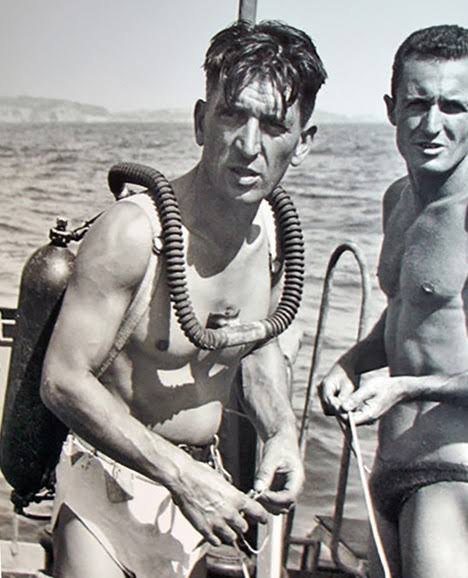
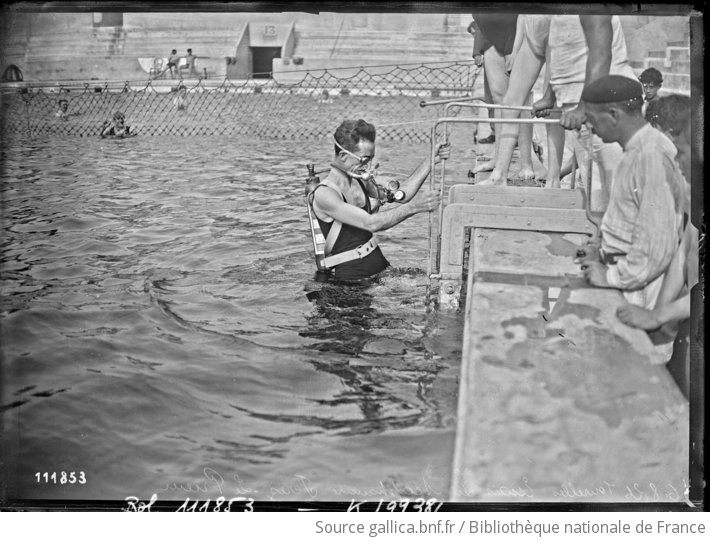
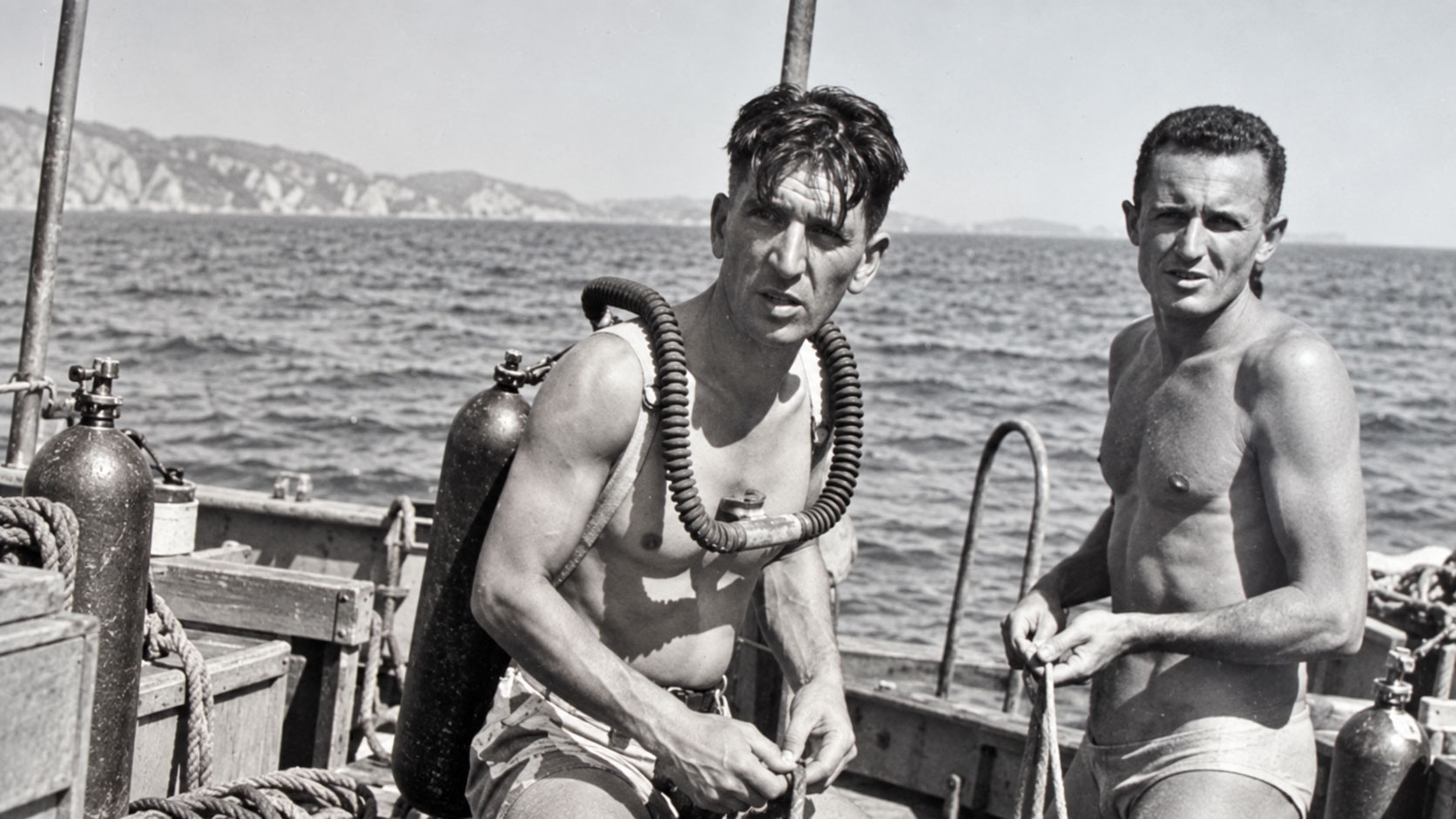
Maurice Fargues, moments before his final dive on 17 September 1947. Fargues is seen wearing an early Cousteau–Gagnan Aqua-Lung, equipped with the characteristic twin corrugated breathing hoses of the period. The man standing behind him on the right is pioneering diver Frédéric Dumas, who is holding the safety line attached to Fargues. During the dive, Dumas monitored that line from the surface as Fargues descended along the weighted line toward 120 metres. When Fargues stopped responding to the agreed signals, Dumas began hauling him back up. Fargues was later recovered unconscious and could not be revived. The photograph was taken only moments before what became one of the defining tragedies of early scuba-diving history.
The Fontaine-de-Vaucluse Expedition
On 27 August 1946, the team travelled to Fontaine-de-Vaucluse, a powerful karst spring in southern France. They hoped to explore its submerged passages and investigate the source of its seasonal flooding.
Fargues remained at the surface, controlling the guide rope used to communicate with the divers below.
The operation nearly ended in disaster.
Tailliez and another diver, Guy Morandière, experienced serious symptoms underwater and struggled to return. Cousteau and Dumas later entered the spring and were also overcome.
Fargues and Tailliez pulled Cousteau and Dumas back towards the surface, probably saving their lives. The incident was later associated with contaminated breathing air entering the cylinders during filling.
Only a year later, Cousteau and Dumas would be unable to save the man who had helped rescue them.
The Attempt to Find the Limit
In September 1947, the Underwater Research Group organised a series of deep dives near the French naval base at Toulon.
The objective was to determine how deep an Aqua-Lung diver could descend while breathing compressed air.
A weighted descent line was prepared with small slates positioned at intervals of approximately ten metres. Fargues would sign each slate as he passed it, providing physical evidence of the depth he had reached.
A safety line connected him with the surface team. By pulling on it periodically, he could signal that he remained conscious and in control.
Fargues began his descent on 17 September.
For the first few minutes, the signals continued. Then, at extreme depth, they stopped.
What Happened at 120 Metres?
When Fargues stopped responding, Philippe Tailliez ordered the team to pull him up immediately.
Diver Jean Pinard descended to meet him at approximately 60 metres. Fargues was unconscious, and his regulator mouthpiece was no longer in his mouth.
The team brought him to the surface and attempted to revive him, but he could not be saved.
A slate carrying his roughly written signature was recovered from approximately 120 metres. It confirmed that he had reached a record depth before losing consciousness.
The precise physiological sequence cannot now be established with certainty. At 120 metres, however, a diver breathing air faces several extreme hazards.
The partial pressure of nitrogen can cause profound narcosis, leading to confusion, loss of coordination and unconsciousness. The partial pressure of oxygen is also far above limits accepted in modern diving and can produce central nervous system oxygen toxicity without warning.
The increased density of compressed air would also make breathing much more difficult.
Fargues most likely became incapacitated at depth, lost his mouthpiece and drowned. Whether nitrogen narcosis, oxygen toxicity or a combination of factors caused the initial loss of consciousness remains uncertain.
WHY WAS THE DIVE SO DANGEROUS?
At 120 metres, the ambient pressure is approximately 13 bar.
A diver breathing ordinary air at this depth is exposed to extreme nitrogen narcosis, dangerously high oxygen pressure and very dense breathing gas.
A dive of this kind would be far outside modern recreational limits and should never be attempted without specialised technical training, suitable mixed gases and extensive surface support.
Was Maurice Fargues the First Aqua-Lung Fatality?
Maurice Fargues is generally recognised as the first diver known to have died while using an Aqua-Lung.
The equipment itself did not simply fail. The Aqua-Lung continued delivering compressed air at depth, but breathing remained only one part of the challenge.
His death exposed a fundamental truth: equipment might allow a diver to descend farther than the human body and mind could safely tolerate.
The tragedy demonstrated that the new freedom offered by autonomous diving required a much deeper understanding of pressure, breathing gases and human physiology.
What Changed After the Accident?
Following the fatal dive, the Underwater Research Group reconsidered the limits of deep diving on compressed air.
The group reportedly concluded that approximately 90 metres represented the maximum practical depth for an air diver at the time. By modern recreational standards, even that depth is extraordinarily dangerous.
Later developments in diving would introduce helium-based breathing mixtures, improved decompression procedures, better regulators, redundant equipment and more structured safety systems.
Helium reduces the narcotic effect of the breathing mixture and lowers gas density, but deep mixed-gas diving still carries substantial risks and requires specialised training.
Fargues’ final dive belonged to a period in which many of these solutions had not yet been developed.
The Diver Who Had Saved Cousteau
The loss was deeply personal for the members of the Underwater Research Group.
Only one year earlier, Fargues had helped bring Cousteau and Dumas back from the dangerous Fontaine-de-Vaucluse expedition. His actions had almost certainly prevented that operation from becoming another fatal chapter in diving history.
Cousteau later expressed the group’s lasting grief, writing that he and Dumas owed their lives to Fargues and would never be consoled that they had been unable to save him.
His death also forced Cousteau to question whether the pursuit of extreme depth with the Aqua-Lung was justified.
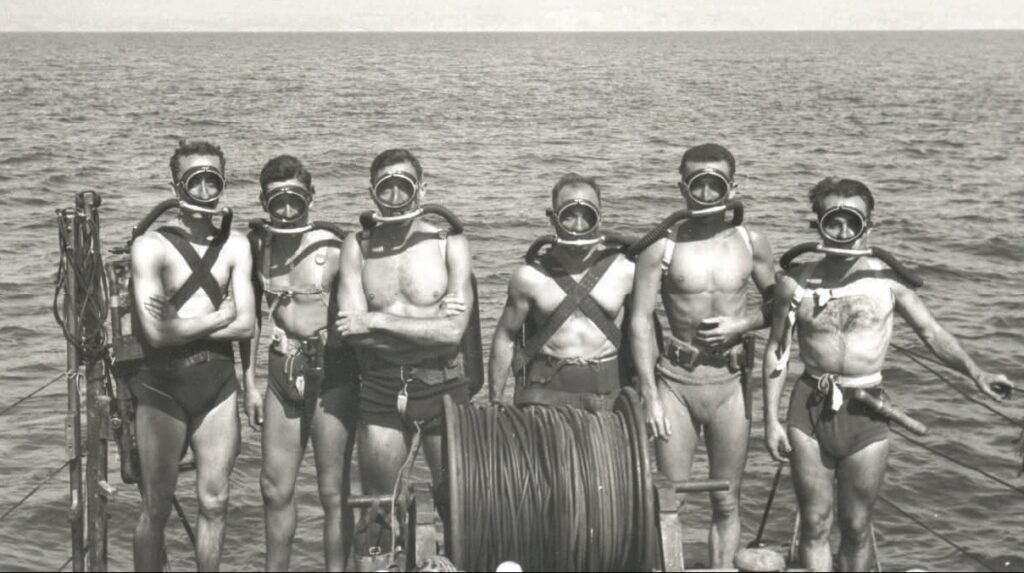
The French Navy’s Groupe de Recherches Sous-Marines (GRS) in 1947. From left: Jacques-Yves Cousteau, Georges, Philippe Tailliez, Jean-Paul Pinard, Frédéric Dumas and Guy Morandière. The small gap deliberately left between Tailliez and Pinard marks the absence of Maurice Fargues, who had died during a deep-diving experiment on 17 September 1947. The image became a quiet tribute to their lost teammate and to one of the earliest fatalities in the history of modern scuba diving.
Remembering Maurice Fargues
Maurice Fargues died at the age of 34, before modern scuba diving had fully emerged.
He did not live to see the Aqua-Lung become commercially successful, recreational diving expand around the world or scientific knowledge establish safer limits for breathing gases at depth.
For many years, his story remained overshadowed by the more famous figures around him.
In 2007, on the 60th anniversary of his death, a room dedicated to Maurice Fargues was inaugurated at the Frédéric Dumas International Diving Museum in Sanary-sur-Mer. It includes a reproduction of the final signature he left on the slate at 120 metres.
That signature is more than evidence of a depth record. It represents an era when divers entered an almost unknown world with experimental equipment and learned its limits through direct—and sometimes fatal—experience.
Why Is Maurice Fargues Important to Diving History?
Maurice Fargues helped test the equipment and procedures that contributed to the development of modern scuba diving.
His final descent demonstrated that the Aqua-Lung could continue operating at extraordinary depth, but also revealed that technological capability should never be confused with a safe human limit.
Today, divers benefit from decades of research into nitrogen narcosis, oxygen toxicity, decompression, gas density and deep-diving procedures.
Much of that knowledge was built on lessons learned by early pioneers who accepted risks that were not yet fully understood.
Seventy-nine years after his death, Maurice Fargues deserves to be remembered not simply as the first Aqua-Lung fatality, but as one of the people who helped expose the boundaries of the new underwater world.