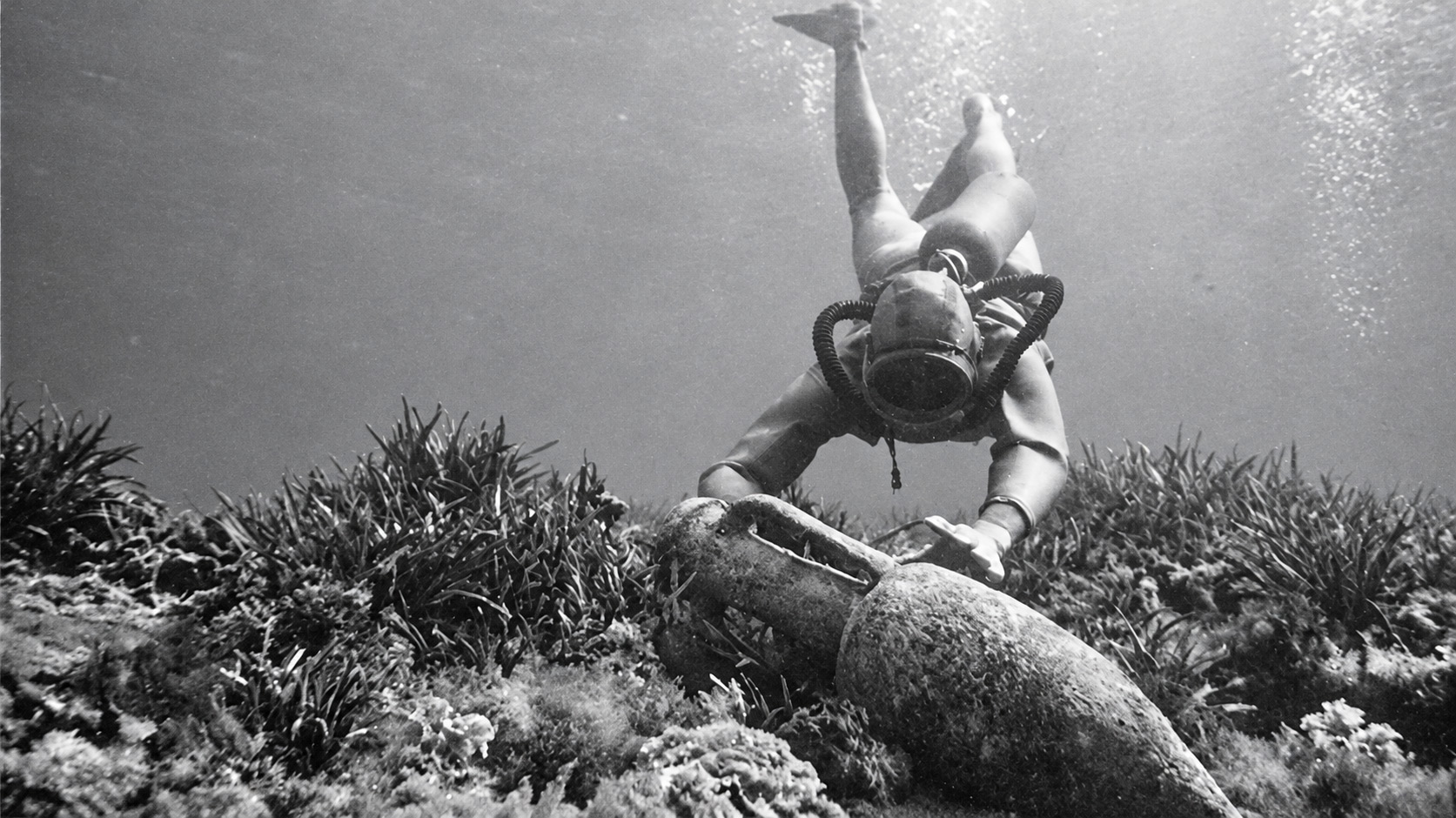
Frédéric Dumas was already exploring the Mediterranean on a single breath before the Aqua-Lung transformed humanity’s relationship with the underwater world.
Nicknamed “Didi,” he became the most naturally gifted diver among the three pioneers later known as Les Mousquemers: Philippe Tailliez, Jacques-Yves Cousteau and Dumas himself.
Cousteau and engineer Émile Gagnan developed the demand regulator that made the modern Aqua-Lung possible. Dumas became one of the divers who tested its limits, demonstrated its potential and helped turn an experimental apparatus into a practical tool for exploration, science, filmmaking and underwater archaeology.
Quick Answer
Frédéric Dumas was a French freediver, scuba pioneer, underwater explorer, writer and archaeologist. Working alongside Jacques-Yves Cousteau and Philippe Tailliez, he tested the early Cousteau–Gagnan Aqua-Lung, completed a landmark 62-metre dive in 1943 and appeared in some of the first films showing autonomous scuba diving.
He later worked as a civilian expert with the French Navy’s underwater research group, served as a leading diver aboard Calypso and helped establish some of the methods used during the early development of underwater archaeology.
FRÉDÉRIC DUMAS: QUICK FACTS
Born: 1913
Died: 26 July 1991
Nickname: Didi
Known for: Testing the early Aqua-Lung and pioneering autonomous diving
Historic dive: 62 metres on 15 October 1943
Key collaborators: Philippe Tailliez and Jacques-Yves Cousteau
Other work: Underwater filmmaking, equipment development, writing and archaeology
Who Was Frédéric Dumas?
Frédéric Dumas was born in France in 1913 and spent most of his life in Sanary-sur-Mer on the Mediterranean coast.
Long before scuba equipment became widely available, he developed an extraordinary familiarity with the sea through swimming, freediving and underwater hunting. He learned to move below the surface with minimal equipment and became known for his physical ability, confidence and intuitive understanding of the underwater environment.
This experience distinguished him from many early experimental divers. Dumas did not approach the sea primarily as an engineer or naval officer. He approached it as someone who had already spent years learning how to function beneath the surface.
His practical ability would become invaluable when a new breathing apparatus arrived on the Mediterranean coast in 1943.
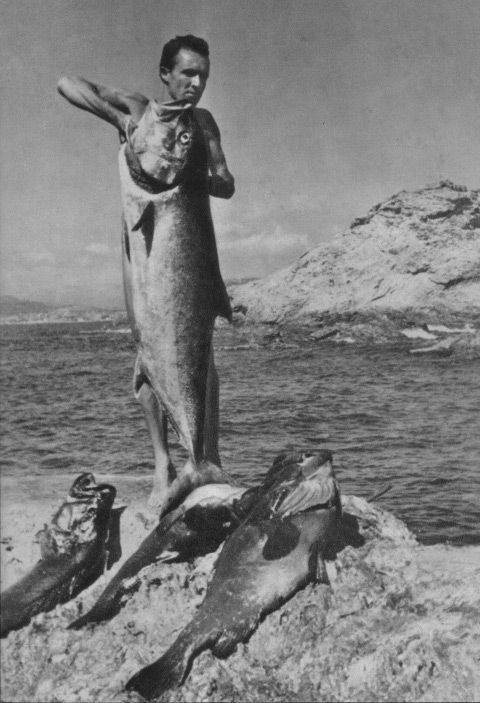
Long before the Aqua-Lung, Dumas was already an exceptional swimmer, freediver and underwater hunter, renowned for his natural ability beneath the surface.
How Did Dumas Meet Tailliez and Cousteau?
Philippe Tailliez encountered Dumas during the late 1930s and immediately recognised his exceptional ability as a swimmer and freediver.
Tailliez introduced him to Jacques-Yves Cousteau, another French naval officer fascinated by underwater exploration and filmmaking. The three men shared a desire to move beneath the sea with greater freedom than traditional surface-supplied diving equipment allowed.
Their personalities and skills complemented one another.
Tailliez brought naval experience, discipline and a growing understanding of the marine environment. Cousteau possessed the ability to organise projects, develop technology and communicate the underwater world through film. Dumas contributed exceptional practical diving ability and an instinctive understanding of how equipment behaved underwater.
Together, they began experimenting, filming and exploring along the French Mediterranean coast.
Many years later, Tailliez gave the trio the name Les Mousquemers, a play on Les Mousquetaires—the Musketeers—and the French word mer, meaning sea.
The Diver in Front of Cousteau’s Camera
Before the arrival of the Aqua-Lung, Dumas became the central underwater figure in Cousteau’s early filmmaking.
He appeared in Par dix-huit mètres de fond—Eighteen Metres Deep—filmed in 1942 using breath-hold diving. His fluid movement and ability to remain underwater made him an ideal subject for Cousteau’s camera.
When the Cousteau–Gagnan apparatus became available the following year, Dumas again became the diver exploring its possibilities in front of the lens.
The 1943 film Épaves—Wrecks—was among the earliest films to show a diver moving underwater with the new autonomous breathing apparatus. The images offered audiences something extraordinary: a human being swimming independently beneath the sea without a hose connecting him to the surface.
Dumas was not simply performing for the camera. His dives were helping the team understand how the equipment worked during real underwater exploration.
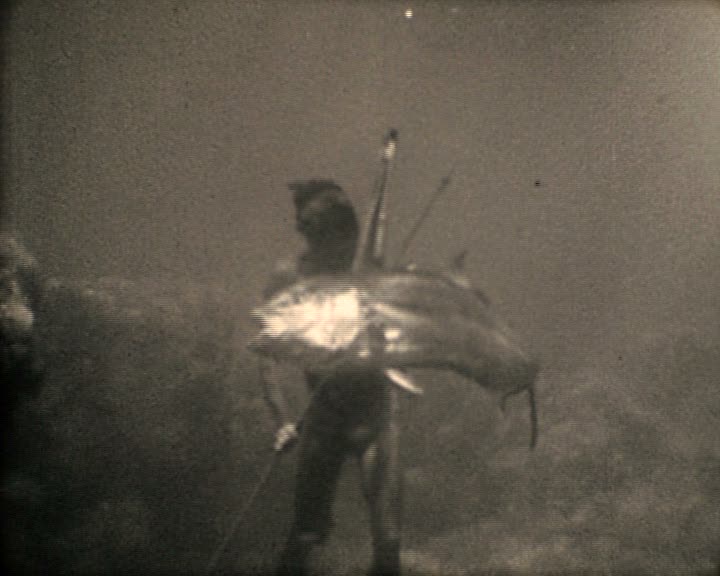
Frédéric Dumas with a large fish caught while freediving, in an image from the filming of Par dix-huit mètres de fond (Eighteen Metres Deep, 1942).
Testing the Cousteau–Gagnan Aqua-Lung
In June 1943, Cousteau received the new autonomous diving apparatus developed with Émile Gagnan.
The system used a demand regulator to deliver air at the pressure surrounding the diver. Unlike equipment that supplied air continuously, it provided air when the diver inhaled, making the cylinder’s contents last longer and allowing much greater freedom of movement.
Cousteau concentrated heavily on filming the new underwater experience. Dumas was entrusted with learning how far the apparatus—and the diver using it—could safely go.
The early team did not have modern dive computers, established recreational depth limits or decades of accumulated decompression knowledge. They were exploring the capabilities and dangers of autonomous diving while the discipline itself was still being created.
Their achievements were remarkable, but the risks they accepted should be understood in their historical context rather than copied by modern divers.
PIONEERING DID NOT MEAN SAFE BY MODERN STANDARDS
The early Aqua-Lung divers were operating without the training systems, instruments, redundant equipment and physiological knowledge available today.
Their experimental dives helped identify the risks that modern procedures are designed to control. They should be remembered as historical milestones—not treated as models for recreational deep diving.
The Historic 62-Metre Dive
On 15 October 1943, Dumas descended to 62 metres using a prototype Cousteau–Gagnan apparatus off Les Goudes, near Marseille.
The dive became one of the first major achievements associated with the new Aqua-Lung and demonstrated that an autonomous diver could reach depths previously associated mainly with heavy, surface-supplied equipment.
At 62 metres, however, Dumas was far beyond what would now be considered normal recreational limits. The partial pressure of nitrogen was high, air was dense and consumption increased dramatically. The effects of nitrogen narcosis also became a serious concern.
The achievement showed the potential of the apparatus while also revealing that greater freedom underwater brought new physiological risks.
Today, the 62-metre dive remains central to Dumas’s legacy. The Musée Frédéric Dumas incorporated the number 62 into its visual identity as a reference to the event.
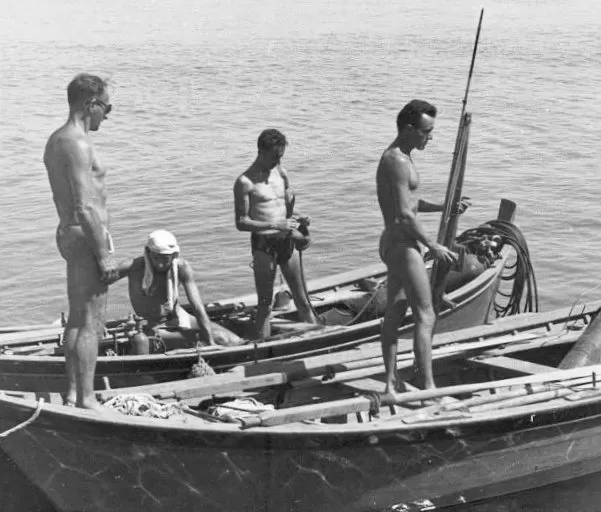
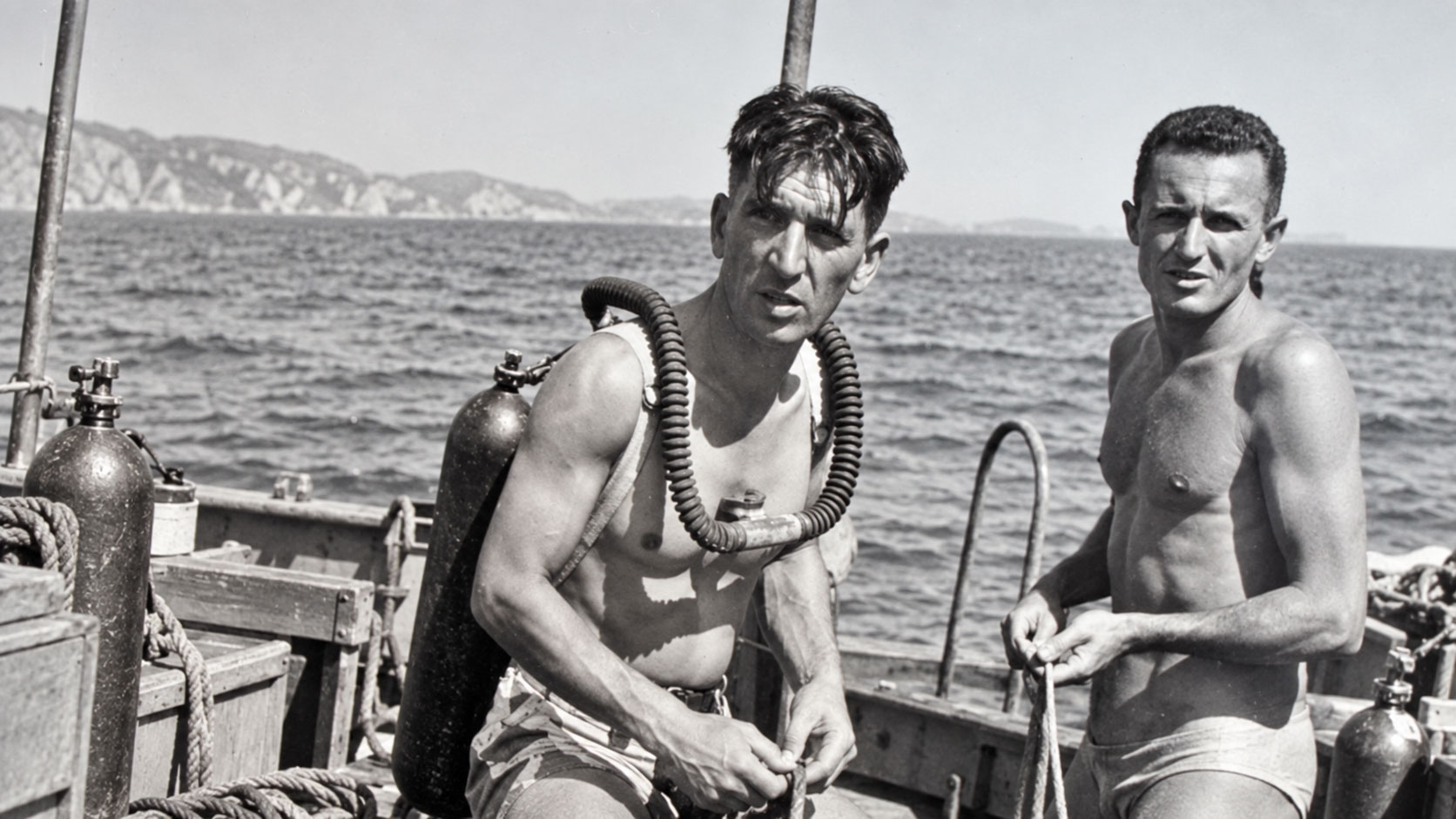
The “Mousquemers” — Philippe Tailliez, Jacques-Yves Cousteau and Frédéric Dumas — the pioneering trio whose experiments, dives and films helped shape the early years of modern scuba diving.
Dumas and the French Navy’s GRS
In 1945, the French Navy established the Groupe de Recherches Sous-Marines, or GRS, to study and develop underwater diving.
Philippe Tailliez became its first commander, with Cousteau as his deputy. Dumas joined the programme as a civilian expert and remained associated with the French Navy’s underwater research work for many years.
His roles included diving, training personnel, testing equipment and contributing practical knowledge to experimental programmes. His experience helped bridge the gap between an apparatus that functioned in principle and equipment that divers could use effectively in demanding conditions.
The GRS examined diving equipment, underwater physiology, operational procedures, filming and the possible military and scientific uses of autonomous diving.
Dumas also helped train a new generation of French Navy divers, including men who would take part in some of the earliest experimental deep dives of the Aqua-Lung era.
From Exploration to Underwater Archaeology
Dumas understood early that scuba was not merely a way to remain underwater. It was a tool that allowed people to work, observe, document and investigate submerged sites.
In 1948, Dumas, Tailliez and Cousteau travelled to the wreck of Mahdia off Tunisia. Equipped with autonomous diving apparatus, they carried out what the French Ministry of Culture describes as an early underwater archaeological survey.
The methods were still developing, and early underwater exploration did not always follow the scientific standards expected today. Nevertheless, these projects demonstrated that divers could examine archaeological sites directly rather than relying solely on objects recovered by nets, dredges or hard-hat divers.
Dumas later participated in important Mediterranean excavations and became highly experienced in organising underwater archaeological work.
He contributed to the development and use of equipment such as:
- Sediment-removal systems for exposing buried remains.
- Photographic frames for systematically documenting wreck sites.
- Methods for recording ancient ship construction.
- Practical procedures for organising divers on underwater excavations.
His expertise was eventually sought by archaeologists working in France and across the eastern Mediterranean.
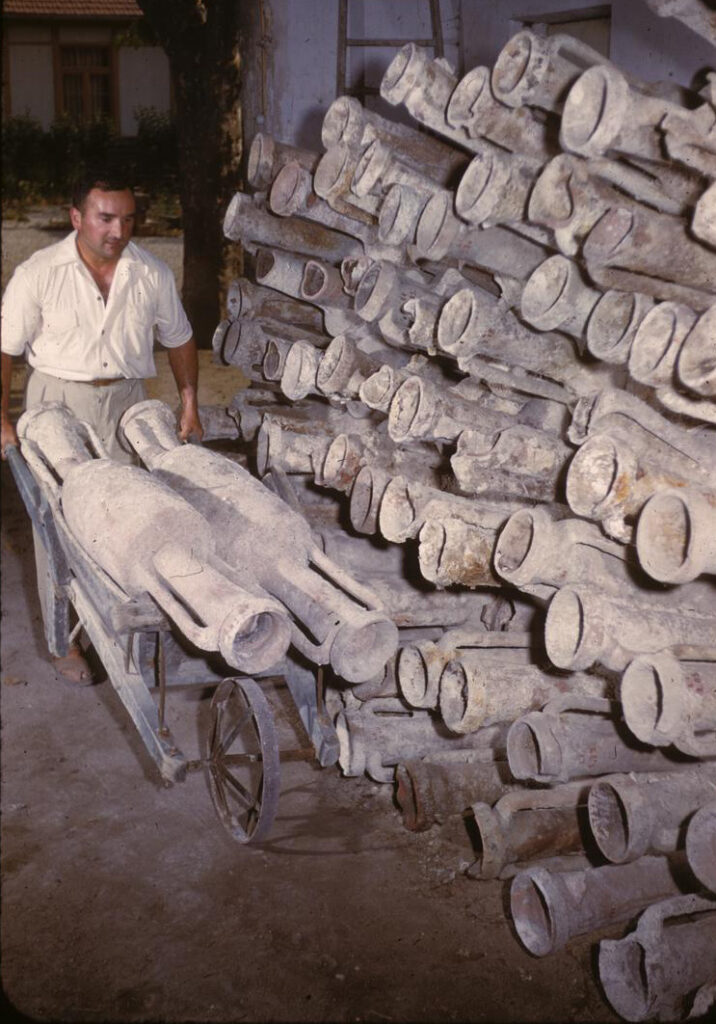
Artefacts recovered from the Grand Congloué excavation, one of the earliest large-scale underwater archaeological projects conducted with scuba equipment.
The Grand Congloué Excavation
One of the most important projects associated with Dumas was the excavation of the ancient wreck site at Grand Congloué near Marseille.
Dumas learned about the site through Mediterranean divers and helped bring it to the attention of Cousteau and the Calypso team. Beginning in the early 1950s, the wreck became the subject of an extensive underwater excavation using scuba equipment.
The work recovered large numbers of amphorae and other artefacts. It also exposed the difficulties of interpreting a complex archaeological site underwater. What was initially treated as a single wreck was later understood to involve material from more than one ancient shipwreck.
Although archaeological practice has advanced enormously since then, Grand Congloué was a landmark in the transition from underwater treasure recovery towards organised scientific excavation.
Dumas’s practical experience on the seabed played an important part in that transition.
Chief Diver Aboard Calypso
Dumas continued his collaboration with Cousteau as a leading diver aboard the research vessel Calypso.
Life aboard the ship combined exploration, experimental technology, science and filmmaking. Dumas worked both behind the scenes and in front of the camera, helping diving teams operate safely while becoming one of the recognisable underwater figures in Cousteau’s films.
He participated in the expeditions connected with The Silent World, released in 1956 and directed by Cousteau and Louis Malle. The film won the Palme d’Or at Cannes and the Academy Award for Best Documentary Feature, bringing underwater exploration to an enormous international audience.
Dumas also co-authored the book The Silent World with Cousteau. The work was based partly on their accumulated notes, experiences and thousands of dives during the formative years of autonomous underwater exploration.
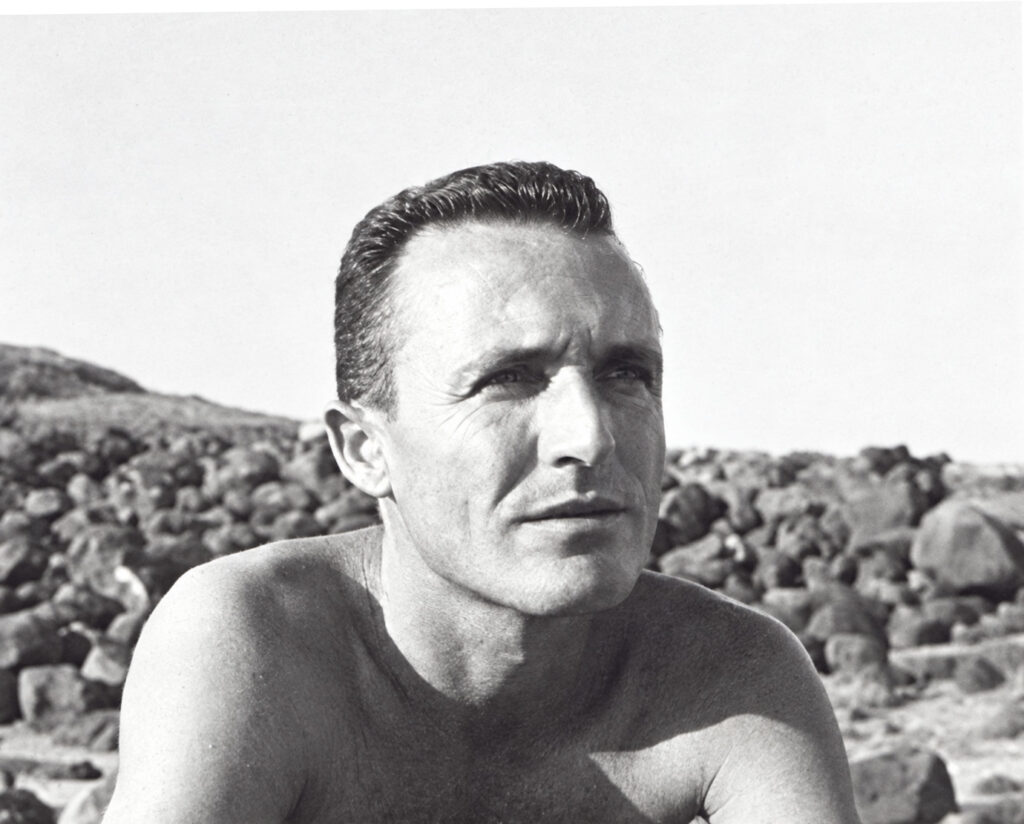
Frédéric Dumas, one of the three Mousquemers, later served as chief diver aboard Calypso and played a central role in its early underwater expeditions.
More Than Cousteau’s Diver
Dumas is sometimes remembered simply as the man swimming in front of Cousteau’s camera. That description seriously understates his contribution.
He was a highly experienced diver, trainer, equipment experimenter, archaeological field specialist and writer. He helped determine how the early Aqua-Lung could be used in practice and passed that knowledge to other divers.
His physical skill gave Cousteau the underwater images he needed, but Dumas was not merely a photographic subject. He helped make those images possible by developing the techniques, equipment knowledge and working methods behind them.
His books and articles also preserved observations from an era in which divers were entering a world that had rarely been seen directly by the wider public.
Why Is Frédéric Dumas Less Famous?
Cousteau became an international media figure whose name was inseparable from Calypso, television documentaries and marine exploration.
Tailliez built a respected legacy within French naval diving and later marine conservation. Dumas remained a quieter figure, despite his central role in many of the same developments.
Much of his contribution took place underwater, in workshops, during training or behind the camera. As the fame of Cousteau grew, the individual work of the people around him became less visible to international audiences.
Dumas died on 26 July 1991. A museum in Sanary-sur-Mer now preserves his equipment, documents and contribution to the development of autonomous diving.
The Legacy of “Didi” Dumas
Frédéric Dumas helped demonstrate that the autonomous diver could do more than simply breathe underwater.
A diver could explore wrecks, appear naturally on film, train others, assist scientists and work directly on submerged archaeological sites. The Aqua-Lung provided the technology, but divers such as Dumas discovered how to use that freedom.
His historic 62-metre descent, his work with the GRS, his years aboard Calypso and his contribution to underwater archaeology place him among the defining figures of modern diving.
Cousteau gave millions of people their first view of the underwater world. Dumas was often the man inside that world, showing them how a human being could move through it.
This article examines historical diving achievements. The depths, equipment and procedures used by early pioneers do not represent appropriate practices for modern recreational divers.