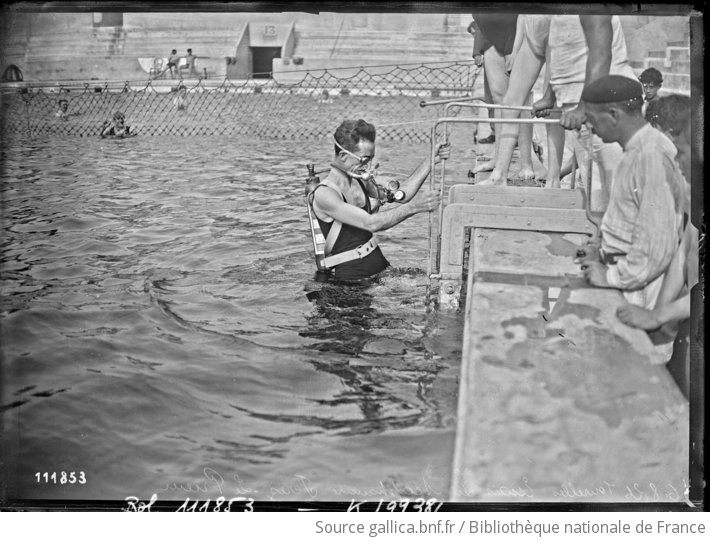
On August 6, 1926, a strange-looking diving apparatus was demonstrated at the Piscine des Tourelles in Paris.
It did not look like modern scuba equipment. There was no dive computer, no buoyancy control device and no familiar second stage regulator. The diver wore goggles, a nose clip, a mouthpiece and a compressed-air cylinder strapped to the body.
But beneath that unusual appearance was a revolutionary idea.
For the first time, a diver could breathe underwater without being connected to the surface.
Quick Answer
The Fernez-Le Prieur apparatus was an early self-contained underwater breathing system demonstrated in Paris on August 6, 1926. It allowed a diver to breathe underwater using a compressed-air cylinder instead of relying on an air hose from the surface.
It was not modern scuba as we know it today, because it did not use a demand regulator. But it was an important step toward underwater freedom and helped pave the way for the Aqua-Lung developed later by Jacques-Yves Cousteau and Émile Gagnan.
The system became known as the Fernez-Le Prieur apparatus, named after French inventor Maurice Fernez and French naval officer Yves Le Prieur. Today, it is remembered as one of the important milestones on the road to modern scuba diving.
It was not yet the Aqua-Lung.
But it helped make the Aqua-Lung possible.
The Problem: Divers Were Still Tied to the Surface
For much of diving history, underwater work depended on heavy equipment and support from the surface.
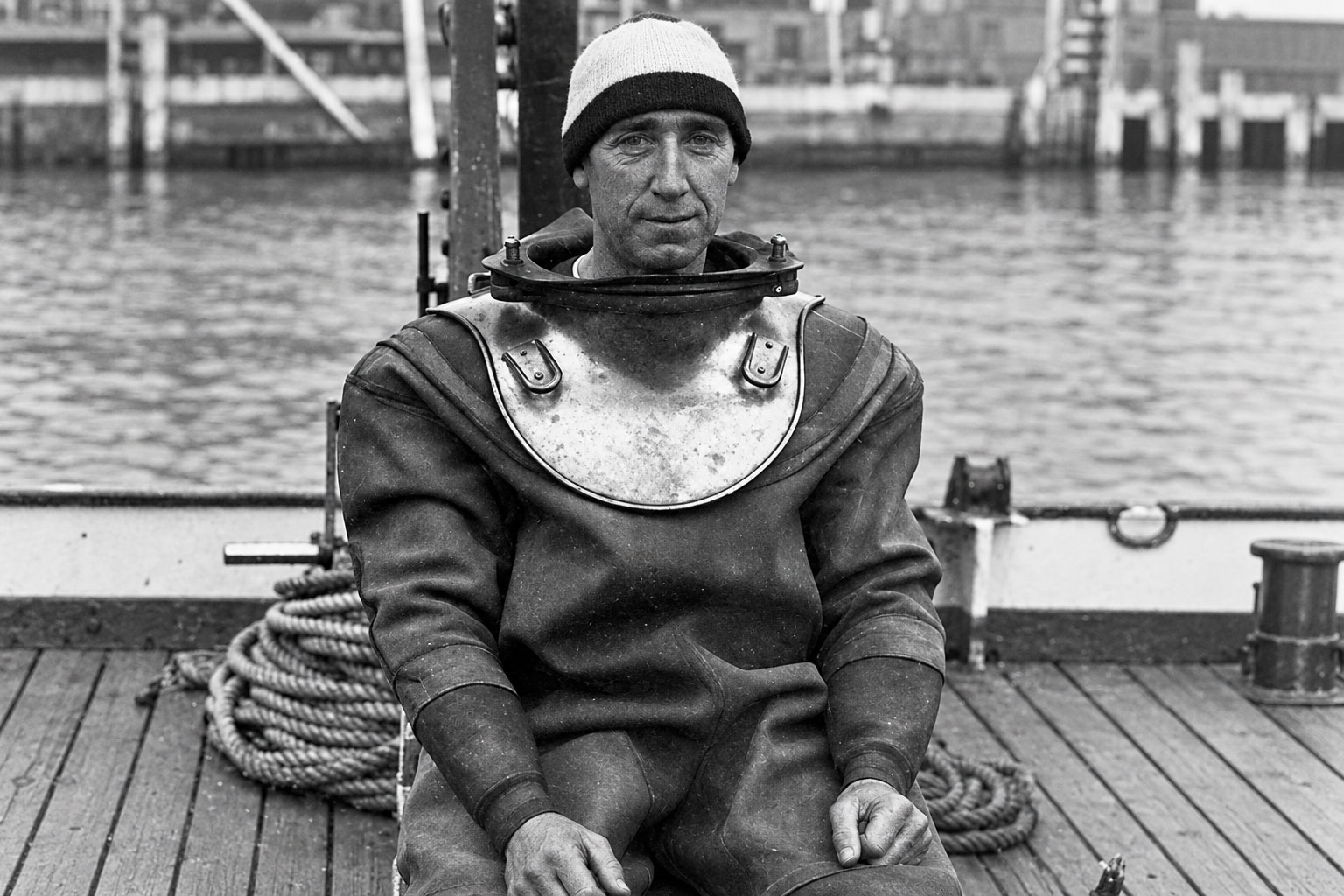
Traditional diving suits used helmets, weighted boots, hoses and pumps. They allowed people to work underwater, but they also limited movement. The diver was connected to the surface by an air hose and depended on a team above.
This made sense for commercial and military diving, but it was far from the freedom recreational divers know today.
The dream was simple: could a person carry their own air supply and move freely underwater?
That question would define the future of scuba.
Key Facts
Date: August 6, 1926
Location: Piscine des Tourelles, Paris, France
Inventors: Maurice Fernez and Yves Le Prieur
Type of system: Early self-contained underwater breathing apparatus
Why it mattered: It helped free divers from surface-supplied air systems
Main limitation: It did not use a demand regulator like modern scuba equipment
Historical importance: A major milestone before the Cousteau-Gagnan Aqua-Lung
Maurice Fernez and the First Step
Maurice Fernez was already experimenting with lighter underwater breathing systems. His work included goggles, mouthpieces and breathing equipment designed to make underwater movement easier.
His early systems were still supplied with air from the surface, but they introduced important ideas that later influenced self-contained diving equipment.
Fernez helped move diving away from the image of the heavy helmeted diver and toward something lighter, more mobile and more human.
That was the foundation Yves Le Prieur would build on.
Yves Le Prieur’s Idea
Yves Le Prieur was a French naval officer, inventor and aviation pioneer. In the mid-1920s, he saw Fernez’s underwater breathing system and imagined a different possibility.
What if the air hose was removed?
What if the diver could take the air supply underwater?
Le Prieur adapted the concept by using a compressed-air cylinder carried by the diver. Instead of being tied to a pump at the surface, the diver had a limited but independent supply of air.
The result was the Fernez-Le Prieur apparatus.
It was a major step toward the idea of self-contained underwater breathing.
August 6, 1926: The Demonstration in Paris
The Fernez-Le Prieur apparatus was publicly demonstrated on August 6, 1926, at the Piscine des Tourelles in Paris.
Historic press photographs from that day show Captain Le Prieur wearing the equipment before entering the pool. To modern divers, the system looks almost primitive. But in 1926, it represented something extraordinary: underwater independence.
The diver was no longer completely dependent on a hose from the surface.
That change may sound simple today, but it was a turning point in the way people imagined underwater exploration.
The sea was no longer only a workplace for helmet divers.
It was becoming a place that individuals could explore more freely.
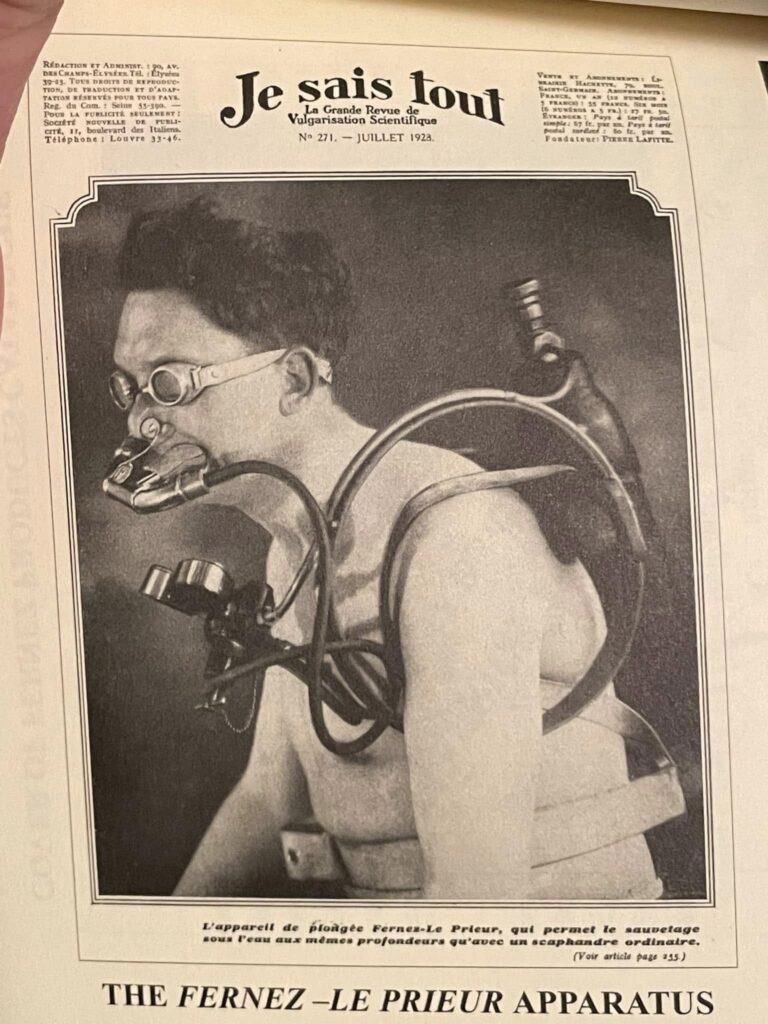
The early Fernez diving apparatus/precursor, featured in the French science magazine Je sais tout in July 1923. The system allowed a diver to operate underwater without the traditional heavy diving helmet.
How Did the Fernez-Le Prieur Apparatus Work?
The Fernez-Le Prieur apparatus used a compressed-air cylinder carried by the diver and a manually controlled air supply.
This is one of the most important differences from modern scuba.
The system did not have a demand regulator like the Aqua-Lung developed later by Jacques-Yves Cousteau and Émile Gagnan. A modern regulator delivers air when the diver inhales. The Fernez-Le Prieur system used a continuous or manually adjusted flow of air.
That meant air was used quickly.
The diver had freedom, but not endurance.
It was a breakthrough, but also a compromise.
Was the Fernez-Le Prieur Apparatus the First Scuba Gear?
The Fernez-Le Prieur apparatus was one of the first practical self-contained underwater breathing systems, but it should not be described as modern scuba.
Modern scuba truly became practical with the development of the Aqua-Lung in the 1940s. The Cousteau-Gagnan regulator made underwater breathing far more efficient because it supplied air on demand.
That changed everything.
It extended dive time, improved comfort and helped open underwater exploration to scientists, filmmakers, military divers and eventually recreational divers around the world.
The Fernez-Le Prieur apparatus did not offer that level of performance.
But it did something equally important: it proved that a diver could leave the surface behind.
Why It Matters to Modern Divers
Every modern diver is connected to this story.
When we descend with our own cylinder, breathe from a regulator and move through the water without a hose to the surface, we are living the dream that early inventors were trying to solve.
The Fernez-Le Prieur apparatus reminds us that scuba was not born fully formed. It evolved through curiosity, engineering and the desire to explore a world that had always been just out of reach.
The history of scuba is often told through the story of Cousteau and Gagnan, and for good reason. The Aqua-Lung changed diving forever.
But history rarely begins with one invention.
Before the Aqua-Lung, there were experiments, failures, strange prototypes and brave demonstrations in swimming pools.
The Fernez-Le Prieur apparatus belongs to that earlier chapter.
It was not perfect. It was limited. It was awkward by modern standards.
But it carried a powerful idea: underwater freedom.
On August 6, 1926, in a Paris swimming pool, a diver carried his own air underwater.
It was not yet the future of scuba.
But for a few minutes beneath the surface, the future was visible.