On July 19, 2026, a 31-year-old recreational diver lost her life during a dive off Tioman Island, Malaysia. The official cause of death was Arterial Gas Embolism (AGE)—a condition that many divers have heard of but few fully understand.
Fortunately, AGE is extremely rare. However, when it does occur, it develops rapidly and can become life-threatening within minutes.
The good news is that most cases are preventable. Understanding why they happen is one of the best ways to make every dive safer.
Quick Answer
Arterial Gas Embolism (AGE) is a life-threatening injury that occurs when expanding air damages the lungs during ascent and enters the arterial bloodstream. The air bubbles can block blood flow to vital organs such as the brain or heart, making immediate oxygen administration and hyperbaric treatment critical. Unlike Decompression Sickness (DCS), AGE is caused by lung over-expansion, not by dissolved nitrogen.
What Is Arterial Gas Embolism?
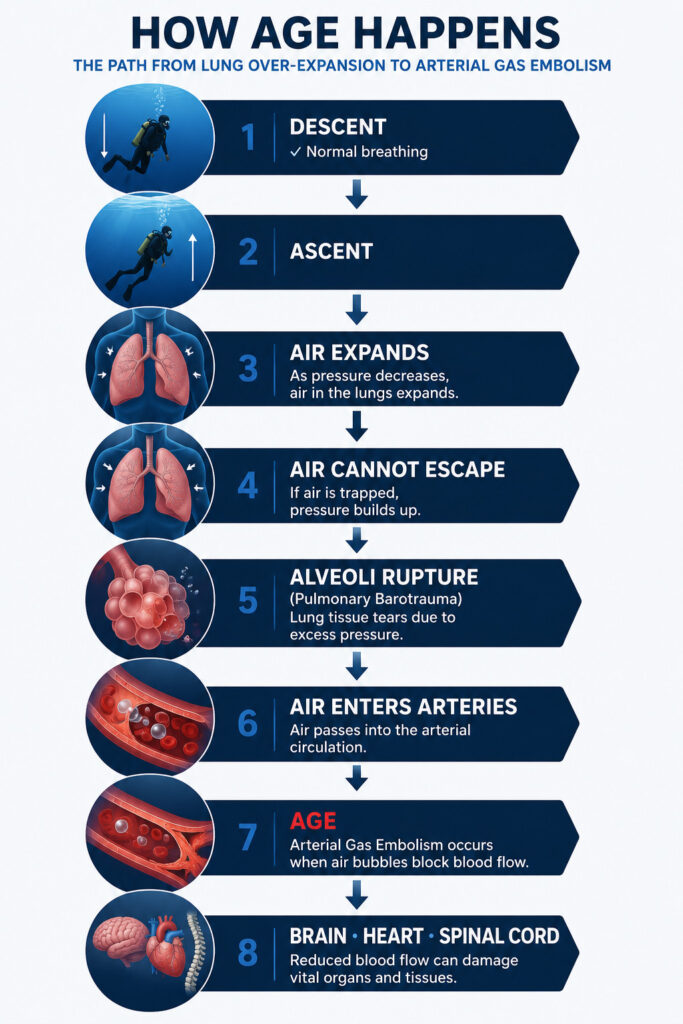
When we breathe compressed air underwater, our lungs fill normally and safely. During ascent, however, the surrounding pressure decreases and the air inside the lungs naturally expands.
As long as a diver continues breathing normally, this expanding air simply leaves the body.
Problems begin when the expanding gas cannot escape.
If pressure builds inside the lungs, the delicate air sacs known as alveoli may rupture. This injury is called pulmonary barotrauma. In some cases, air passes through the damaged lung tissue into the arterial circulation, where it can travel throughout the body.
Once inside the arteries, these air bubbles may block blood flow to organs such as the brain, spinal cord, or heart. This condition is known as Arterial Gas Embolism (AGE).
Key Takeaway
AGE is not caused by nitrogen bubbles. It is caused by air escaping from injured lungs into the arterial bloodstream after lung over-expansion.
Why Does It Happen?
The answer is simple—and it is something every Open Water diver learns on the very first course.
As pressure decreases during ascent, air expands.
Normally, the expanding air leaves the lungs naturally while we breathe.
If that air becomes trapped, pressure continues to rise until the lung tissue can no longer withstand it.
This is why divers are taught one of scuba diving’s most important rules:
Never hold your breath.
Although breath-holding is the most common cause, it is not the only one.
Rapid ascents, panic, certain lung conditions, or anything that traps air inside the lungs may also increase the risk of pulmonary barotrauma.
What Can Cause AGE?
Several situations have been associated with Arterial Gas Embolism.
Holding Your Breath
Even a brief breath-hold during ascent can allow pressure to build inside the lungs.
Fortunately, this is also one of the easiest risks to avoid—simply breathe continuously throughout every dive.
Rapid or Uncontrolled Ascents
An uncontrolled ascent gives expanding air less time to leave the lungs naturally.
Good buoyancy control and maintaining a slow ascent rate greatly reduce this risk.
Lung Conditions
Certain medical conditions can trap air inside the lungs, including asthma, pulmonary blebs, chronic lung disease, or respiratory infections.
For this reason, divers should never dive while suffering from respiratory illness and should always seek medical advice if they have an underlying lung condition.
Air Trapping
In rare cases, a small pocket of trapped air inside the lungs may not empty properly during ascent. As it expands, it can contribute to pulmonary barotrauma.
AGE vs Decompression Sickness: What’s the Difference?
Because both conditions involve gas bubbles, Arterial Gas Embolism (AGE) and Decompression Sickness (DCS) are often confused. In reality, they are two completely different injuries.
AGE occurs when expanding air damages the lungs during ascent and enters the arterial bloodstream. Symptoms usually appear immediately—or within minutes after surfacing—and often include sudden neurological problems such as confusion, paralysis, or loss of consciousness.
Decompression Sickness, on the other hand, is caused by dissolved nitrogen coming out of solution as pressure decreases. Symptoms may not appear until several minutes or even hours after the dive and can range from joint pain and skin rashes to dizziness, numbness, or neurological complications.
Although their causes are different, both conditions should always be treated as diving emergencies. Administering oxygen, seeking medical assistance, and arranging prompt evaluation at a hyperbaric facility can make a significant difference to the outcome.
Signs and Symptoms
One of the defining characteristics of AGE is how quickly symptoms appear.
Most cases develop immediately or within minutes after surfacing.
Possible symptoms include:
- Sudden loss of consciousness
- Confusion
- Difficulty speaking
- Vision changes
- Weakness or paralysis
- Seizures
- Chest pain
- Difficulty breathing
- Dizziness or loss of coordination
Any diver showing neurological symptoms immediately after a dive should be treated as a medical emergency.
What Should You Do?
If AGE is suspected:
- End the dive immediately.
- Administer 100% oxygen if available.
- Contact emergency medical services.
- Arrange evacuation to the nearest hyperbaric facility.
- Monitor breathing and circulation.
- Begin CPR if necessary.
Time matters.
The sooner treatment begins, the better the outcome.
How Is AGE Treated?
The standard treatment for Arterial Gas Embolism is Hyperbaric Oxygen Therapy (HBOT).
Inside a hyperbaric chamber, increased pressure reduces the size of the gas bubbles while breathing pure oxygen helps restore oxygen delivery to injured tissues.
Many divers make excellent recoveries when treatment is started quickly, which is why early recognition is so important.
Can AGE Be Prevented?
Fortunately, yes.
Most cases can be prevented by following the same principles taught during every entry-level scuba course.
- Never hold your breath.
- Breathe continuously throughout the dive.
- Ascend slowly and under control.
- Maintain good buoyancy.
- Stay within your training and certification limits.
- Avoid diving when suffering from respiratory illness.
These habits not only reduce the risk of AGE but also improve overall diving safety.
Did You Know?
A diver can suffer pulmonary barotrauma even after a relatively shallow dive. Because the greatest percentage change in pressure occurs near the surface, the last few metres of an ascent are among the most important.
Final Thoughts
Arterial Gas Embolism is one of the most serious emergencies in scuba diving—but it is also one of the most preventable.
Understanding how it occurs reinforces one of the simplest lessons every diver learns: breathe continuously, ascend slowly, and stay in control.
Those basic habits have protected divers for decades, and they remain the best defence against one of diving’s most dangerous injuries.