Decompression sickness is one of the best-known medical risks associated with scuba diving. Often called “the bends,” it occurs when dissolved inert gas—usually nitrogen—forms bubbles inside the body during or after ascent.
Although modern dive computers and safe diving practices significantly reduce the risk, decompression sickness can still occur after an apparently normal dive. Every diver should therefore understand its symptoms and know how to respond.
Quick Answer
What is decompression sickness?
Decompression sickness, or DCS, occurs when nitrogen absorbed by the body at depth forms bubbles during ascent. These bubbles can affect the joints, skin, nervous system, lungs or other tissues.
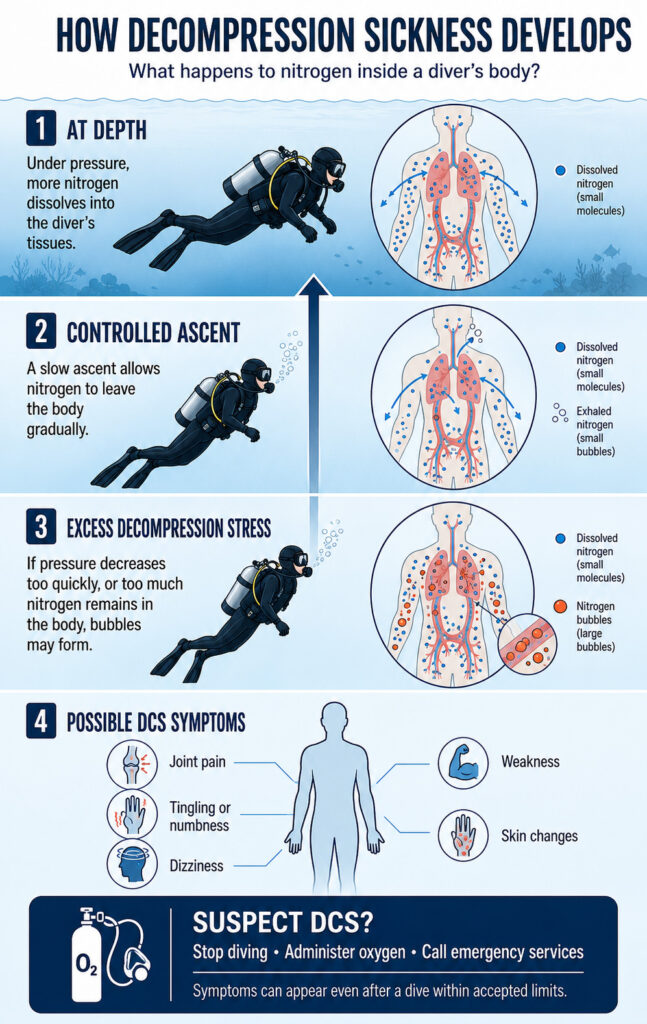
Possible symptoms include unusual fatigue, joint pain, tingling, numbness, dizziness, weakness, skin changes and breathing difficulties. Suspected DCS requires immediate emergency oxygen and medical assessment.
Why Does Decompression Sickness Occur?
While breathing compressed air underwater, the increased pressure causes more nitrogen to dissolve into the body’s tissues. The deeper and longer the dive, the more nitrogen may be absorbed.
During a slow and controlled ascent, this nitrogen is gradually released and carried to the lungs, where it is exhaled. If the pressure decreases too quickly—or the body contains more dissolved nitrogen than it can eliminate safely—bubbles may form inside the tissues and bloodstream.
These bubbles can interfere with circulation, irritate tissues and affect the nervous system.
Can DCS Occur Within No-Decompression Limits?
Yes.
Dive tables and computers are designed to keep the risk within an accepted range, but they cannot guarantee that decompression sickness will never occur. Divers vary in age, health, fitness, circulation and individual susceptibility.
A diver may follow the computer correctly and still develop symptoms. This is why unusual physical or neurological symptoms following a dive should never be ignored simply because “the dive was within limits.”
Did You Know?
A dive computer estimates decompression risk using a mathematical model. It cannot directly measure the amount of nitrogen in your body or determine whether bubbles have formed.
What Are the Symptoms of Decompression Sickness?
Symptoms may appear shortly after surfacing or several hours later. According to DAN, they usually develop between approximately 15 minutes and 12 hours after a dive, although delayed cases can occur.
Common symptoms include:
- Unusual or extreme fatigue.
- Pain in a joint, arm, leg or torso.
- Numbness or tingling.
- Dizziness or vertigo.
- Muscle weakness.
- Itchy skin, a rash or mottled skin.
- Difficulty walking or poor coordination.
- Confusion or unusual behaviour.
- Difficulty urinating.
- Shortness of breath.
- Paralysis, collapse or unconsciousness in severe cases.
DCS does not always begin dramatically. A mild ache, unexplained tiredness or tingling sensation may be the first warning sign.
Do not wait for symptoms to become severe before seeking help.
What Should You Do If You Suspect DCS?
Remove the diver from the water and begin the site’s emergency procedure.
Administer the highest concentration of emergency oxygen available, provided the equipment is present and someone is trained to use it. Contact the local emergency medical services and then a diving medical emergency service such as DAN.
Keep the diver resting, comfortable and under observation. If fully conscious and able to swallow normally, they may be given non-alcoholic fluids. Record the dive profile, times, symptoms, breathing gases and any changes in the diver’s condition.
Even if the symptoms improve or disappear while breathing oxygen, medical assessment is still necessary. Symptoms can return after oxygen administration stops.
Do not allow the diver to:
- Return to the water.
- Fly or travel to altitude.
- Exercise unnecessarily.
- Drink alcohol.
- Attempt in-water recompression.
In-water recompression can expose an injured diver to drowning, oxygen toxicity, cold and worsening symptoms. It should not be attempted by recreational divers.
How Is Decompression Sickness Treated?
The main definitive treatment is recompression with hyperbaric oxygen.
Inside a hyperbaric chamber, the diver breathes oxygen while the surrounding pressure is increased under medical supervision. This helps reduce bubble size, improves oxygen delivery to affected tissues and assists the body in eliminating inert gas.
Treatment may take several hours, and some divers require additional sessions. The exact treatment depends on the symptoms, medical assessment and response to recompression.
Divers should contact emergency medical services first rather than travelling directly to a hyperbaric chamber. Not every chamber is equipped, staffed or available to treat diving emergencies.
DCS and AGE: What Is the Difference?
Decompression sickness and arterial gas embolism are both forms of decompression illness, but they are not the same condition.
DCS is generally caused by inert gas bubbles forming within the body following a reduction in pressure.
AGE usually results from lung overexpansion that allows gas to enter the arterial circulation. It is often associated with breath-holding, trapped air or an uncontrolled ascent, and symptoms commonly appear immediately or within minutes of surfacing.
Both conditions are medical emergencies. Divers should not delay first aid while trying to decide which one has occurred.
Travelling to Altitude After Diving
Flying is not the only form of altitude exposure divers should consider. Driving into the mountains after diving also reduces the surrounding atmospheric pressure and may increase decompression stress.
This is particularly important after deep, repetitive or long dives, and after dives completed close to the no-decompression limit. When planning a dive trip, consider not only the dive itself but also the altitude reached during the journey home.
As a conservative approach, avoid significant altitude exposure on the same day after a demanding dive and follow recognised flying-after-diving waiting periods. Never travel to altitude if any possible symptoms of decompression sickness are present.
How Can Divers Reduce the Risk?
No diving practice can eliminate the risk completely, but sensible habits can reduce it:
- Follow your dive computer and respect depth and time limits.
- Make slow, controlled ascents.
- Complete safety and decompression stops as required.
- Avoid pushing the computer close to its limits on every dive.
- Allow sufficient surface intervals between dives.
- Stay adequately hydrated and rested.
- Avoid intense exertion during and immediately after diving.
- Consider additional conservatism during repetitive, deep or cold-water dives.
- Follow recognised recommendations before flying or travelling to altitude after diving.
Divers should also plan dives according to their training, physical condition and recent diving history—not simply according to the maximum limits displayed by a computer.
Never Ignore Symptoms After Diving
One of the greatest dangers with decompression sickness is denial. Divers may blame pain on carrying equipment, numbness on a tight wetsuit or fatigue on a long day at sea.
If unusual symptoms appear during or after a dive, treat them seriously. Stop diving, administer emergency oxygen and seek professional medical advice.
Early recognition and an appropriate response can make a significant difference to the diver’s recovery.
This article provides general educational information and is not a substitute for professional medical advice or recognised diving first-aid training.