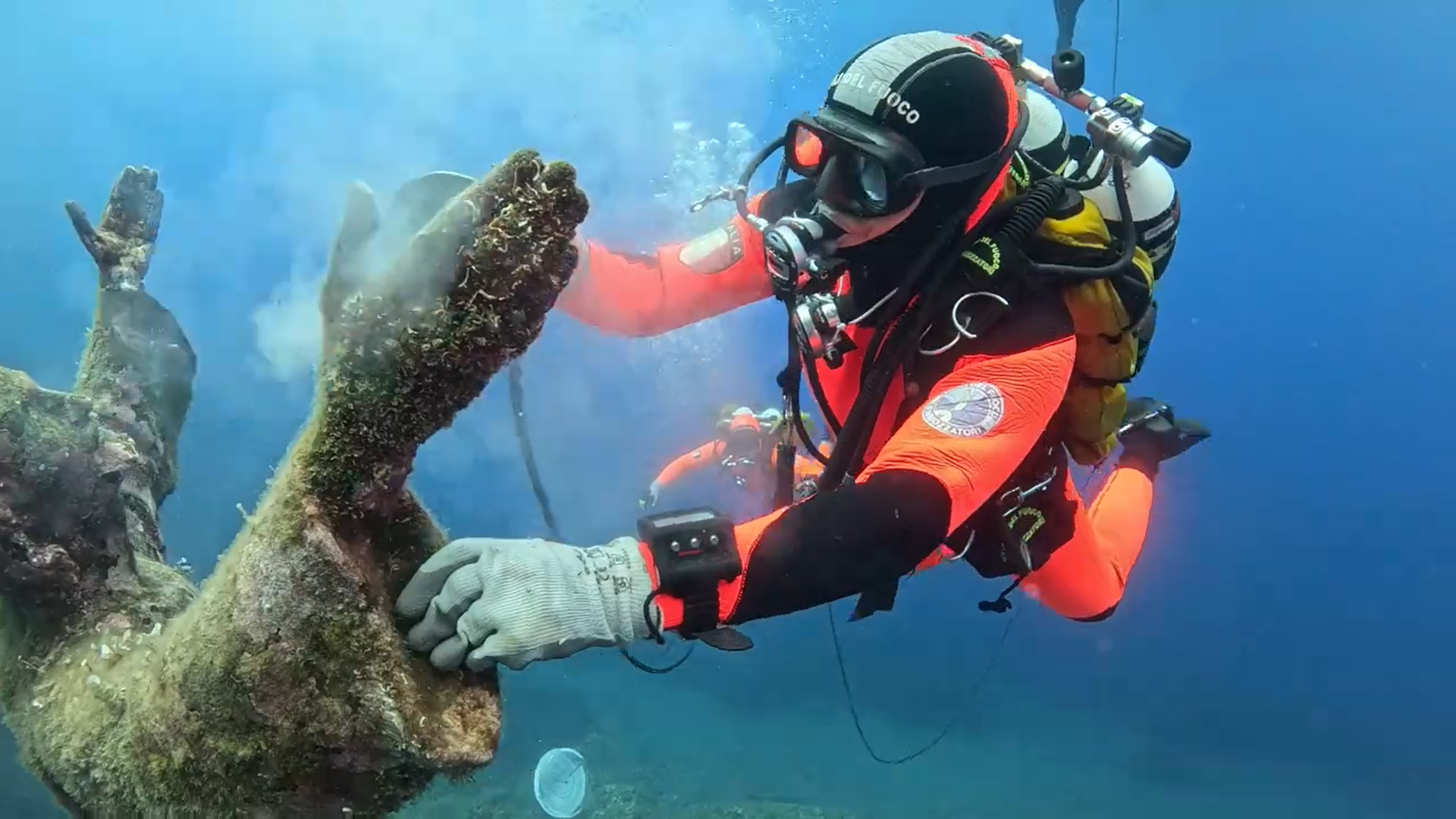
Specialist diving teams have completed the annual Christ of the Abyss cleaning, carefully removing marine growth from one of the world’s most famous underwater statues.
The operation took place on July 21, 2026, in the Bay of San Fruttuoso, between Camogli and Portofino on Italy’s Ligurian coast.
Located at a depth of approximately 18 metres, the bronze statue has become an international symbol of scuba diving, remembrance and peace.
This year’s conservation work brought together divers from several Italian state services, including the Coast Guard, Fire Brigade, Navy, Police, Carabinieri and Guardia di Finanza.
Cleaning Without Touching the Statue
Instead of scrubbing the statue directly, the divers used a special pressure-washing system provided by the Genoa Fire Brigade.
The carefully controlled stream of water removed algae, marine organisms and other deposits without direct contact with the bronze surface.
This is particularly important because older cleaning methods involved metal brushes. Repeated brushing gradually wore away parts of the bronze and damaged its protective surface.
The statue has also been weakened by decades of exposure to seawater, marine growth and galvanic corrosion.
The 2026 operation was organised and coordinated by the Underwater Archaeology Technical Service of the Superintendency of Archaeology, Fine Arts and Landscape for Liguria.
Why Use Pressurised Water?
The contact-free system removes marine deposits without scraping the statue’s fragile bronze surface, reducing further wear while avoiding the use of chemicals underwater.
A Monument Beneath the Mediterranean
The original Cristo degli Abissi, known internationally as the Christ of the Abyss, was placed on the seabed in 1954.
The idea came from Italian diving pioneer Duilio Marcante, while the statue was created by sculptor Guido Galletti.
Standing approximately 2.5 metres tall and weighing around 260 kilograms, it depicts Christ with his head and arms raised toward the surface.
The statue was conceived in memory of those who lost their lives at sea and particularly Marcante’s friend Dario Gonzatti, who died during a dive in the area in 1947.
Its bronze was created using metal from a remarkable collection of donated objects. These reportedly included medals belonging to fallen soldiers and athletes, as well as parts from ships, propellers, bells and cannons.
The result was not simply a religious monument but a memorial shaped from objects connected with war, sport, seafaring and human loss.
An International Symbol of Diving
Over the decades, Christ of the Abyss has become one of the Mediterranean’s most recognisable dive sites.
Its relatively accessible depth allows recreational divers to visit the monument, although dives within the protected marine area must follow local regulations and be conducted responsibly.
The image of the statue reaching upward through the blue water has become one of the most widely recognised symbols of the underwater world.
Copies and monuments inspired by the original can now be found in other locations, including Key Largo in Florida and Malta. However, the statue at San Fruttuoso remains the original and most famous Christ of the Abyss.
Preserving an Underwater Landmark
Maintaining a bronze monument underwater requires a careful balance.
Marine organisms naturally colonise every available surface, gradually changing the statue’s appearance. At the same time, removing this growth too aggressively can damage the already weakened bronze.
The annual operation is therefore not simply a cosmetic cleaning. It forms part of a long-term conservation programme designed to protect a fragile piece of underwater cultural heritage.
Through this year’s contact-free method, the diving teams were able to reveal the statue’s features while minimising further impact on its surface and the surrounding marine environment.
More than 70 years after it was lowered into the Mediterranean, Christ of the Abyss continues to look toward the surface—remembering those lost at sea while welcoming new generations of divers.