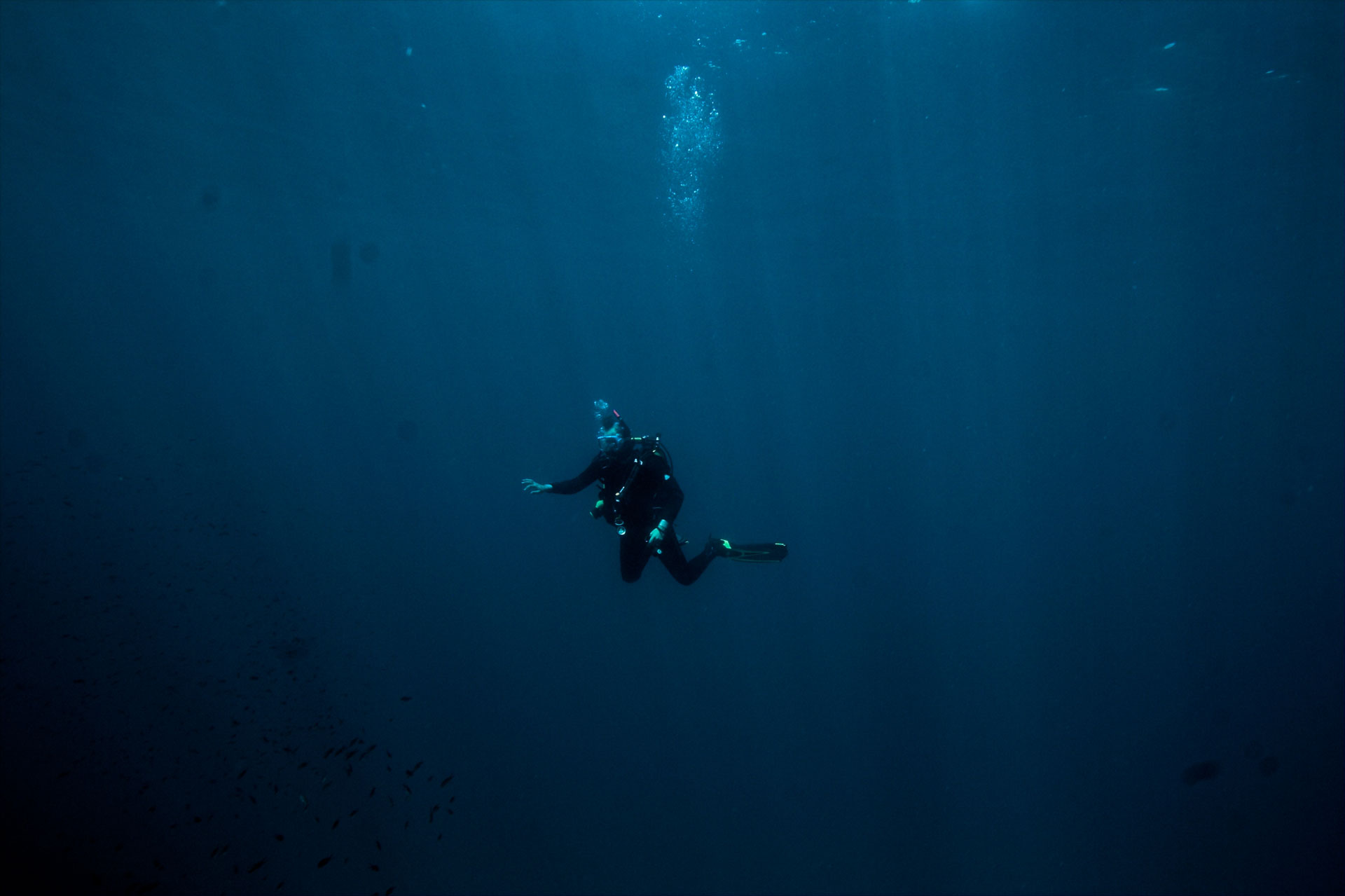
Every diver dreams of hovering effortlessly above the reef.
No constant fin kicks.
No bouncing up and down.
Just complete control.
Yet for many divers, neutral buoyancy is one of the hardest skills to master.
The good news is that poor buoyancy is rarely caused by a single mistake.
It’s usually the result of several small factors working together.
Once you understand them, everything starts to become easier.
Quick Answer
Why can’t I stay neutrally buoyant?
Poor buoyancy is usually caused by a combination of incorrect weighting, improper use of the BCD, breathing habits, body position and lack of experience. Improving buoyancy isn’t about making one big change—it’s about making several small improvements that work together.
Common Mistake
Many divers think neutral buoyancy is controlled mainly with the BCD.
In reality, your BCD, breathing, weighting and body position all work together. Focusing on only one of them usually makes buoyancy harder—not easier.
What Is Neutral Buoyancy?
Neutral buoyancy means you are neither sinking nor floating.
You remain suspended in the water column with minimal effort.
This allows you to:
- Protect the marine environment.
- Reduce air consumption.
- Improve trim.
- Move more efficiently.
- Feel more relaxed underwater.
It’s one of the defining characteristics of an experienced diver.
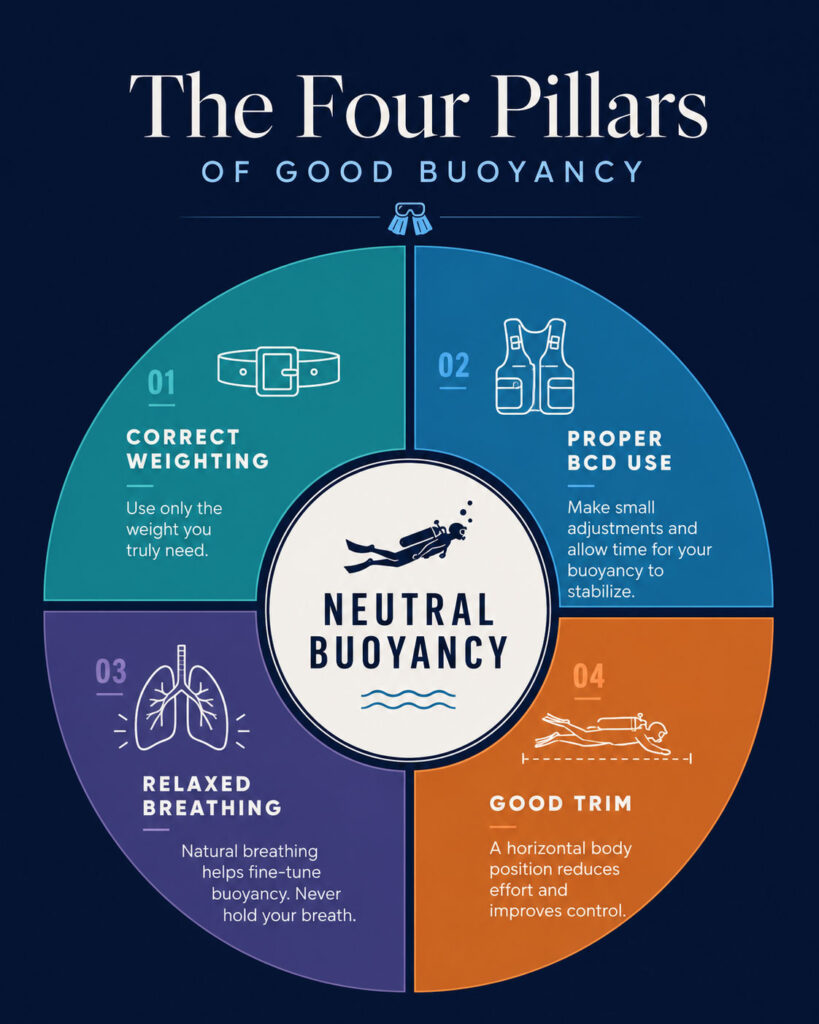
1. Incorrect Weighting
Poor buoyancy often begins before you even enter the water.
If you’re carrying too much lead, you’ll need to add more air to your BCD.
More air means greater buoyancy changes as you ascend and descend, making it much harder to stay stable.
If you’re underweighted, you’ll constantly struggle to descend or remain at depth.
Neither extreme helps.
This is why performing a proper weight check is one of the best investments you can make.
2. Using the BCD Too Much
Your BCD is designed for coarse buoyancy adjustments, not continuous corrections.
Many new divers press the inflator or dump valve every few seconds.
The result is a constant cycle:
- Add air.
- Become too buoyant.
- Dump air.
- Sink.
- Add air again.
Instead, make small adjustments and give your buoyancy time to stabilise before making another.
Water doesn’t respond instantly—and neither does your body.
3. Forgetting That Your Lungs Are Part of Your Buoyancy
Your lungs are your finest buoyancy control device.
A slow, normal inhalation slightly increases your buoyancy.
A relaxed exhalation slightly decreases it.
These natural changes are usually enough to make small depth adjustments without touching your BCD.
The goal isn’t to exaggerate your breathing.
It’s simply to allow your breathing to work with your equipment instead of against it.
4. Poor Trim
Buoyancy and trim go hand in hand.
Even if your buoyancy is correct, poor body position can make you feel unstable underwater.
Many beginner divers swim with their feet pointing downward and their upper body higher than their legs.
This creates unnecessary drag, makes finning less efficient and often leads to constant buoyancy corrections.
Aim for a horizontal, streamlined position with your shoulders, hips and fins aligned as much as possible.
Good trim makes good buoyancy much easier.
5. Trying to Solve Everything with Your Fins
Another common mistake is using your fins to compensate for poor buoyancy.
If you constantly kick to stay at the same depth, something else usually needs attention.
Your fins are designed for propulsion—not for keeping you suspended in the water.
When your weighting, breathing and BCD are properly balanced, you should be able to hover almost effortlessly without continuous fin movement.
Less movement also means lower air consumption and less fatigue.
6. Looking Up or Down
Your head position affects your entire body.
Looking down at the seabed often causes your legs to rise.
Looking up for extended periods can make your body rotate the opposite way.
Try to keep your head in a natural position and look where you’re going rather than constantly looking straight down.
Small posture changes can have surprisingly large effects underwater.
7. Rushing the Learning Process
Neutral buoyancy isn’t mastered in a weekend.
It’s a skill that improves with every dive.
Many experienced instructors say that divers usually begin to feel truly comfortable after 30–50 dives, although everyone progresses at a different pace.
The important thing is not to compare yourself with divers who have hundreds of dives.
Every dive teaches you something new.
Did You Know?
Many experienced divers spend entire dives without touching their BCD inflator. Once properly weighted, they make only occasional adjustments and use their breathing for fine buoyancy control.
Practical Tips to Improve Your Buoyancy
You don’t need expensive equipment to become more buoyant underwater.
Focus on these habits instead:
- Perform a proper weight check whenever your equipment changes.
- Descend slowly and avoid rushing.
- Make small BCD adjustments and wait before making another.
- Practice hovering at the end of every dive.
- Maintain a horizontal body position.
- Relax and breathe naturally.
- Dive regularly—experience is your greatest teacher.
Small improvements made consistently will always outperform one dramatic change.
Final Thoughts
Neutral buoyancy isn’t a talent.
It’s a skill.
Every experienced diver once struggled with it.
The difference is that they kept practising until good buoyancy became second nature.
Don’t aim to be perfectly buoyant on every dive.
Aim to be slightly better than you were on your last one.
Over time, you’ll discover that better buoyancy doesn’t just make diving easier.
It makes every aspect of diving more enjoyable—from air consumption and trim to underwater photography and protecting marine life.