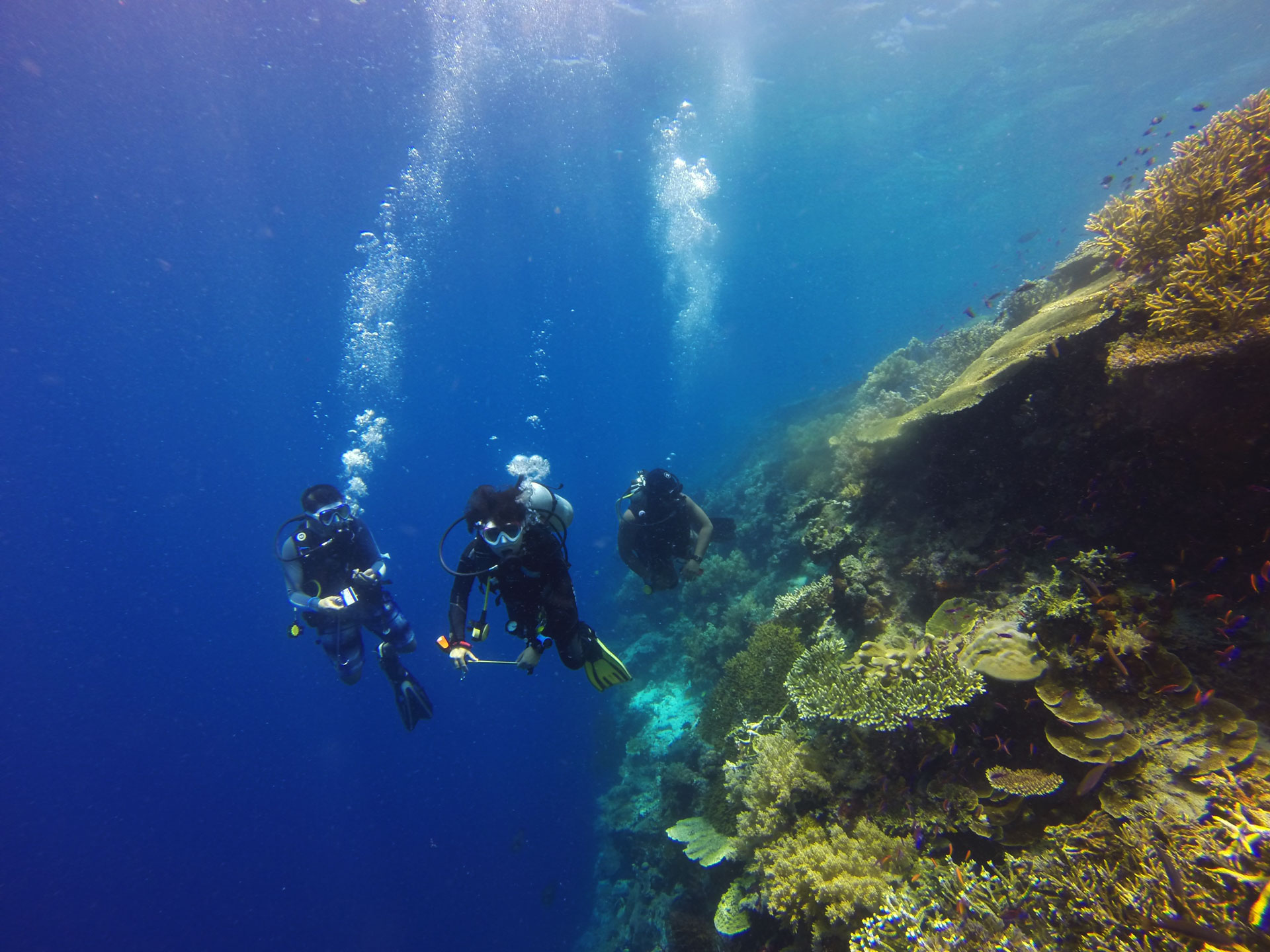
The dive is over.
You’ve explored the reef, checked your pressure gauge and it’s time to head back to the surface.
For many new divers, the ascent feels like the easiest part of the dive.
In reality, it’s one of the most important.
Ascending too quickly can expose your body to unnecessary risks, while a slow, controlled ascent allows it to adapt safely to the changing pressure.
Understanding why we ascend slowly is one of the most valuable lessons every diver can learn.
Quick Answer
Why is a slow ascent important?
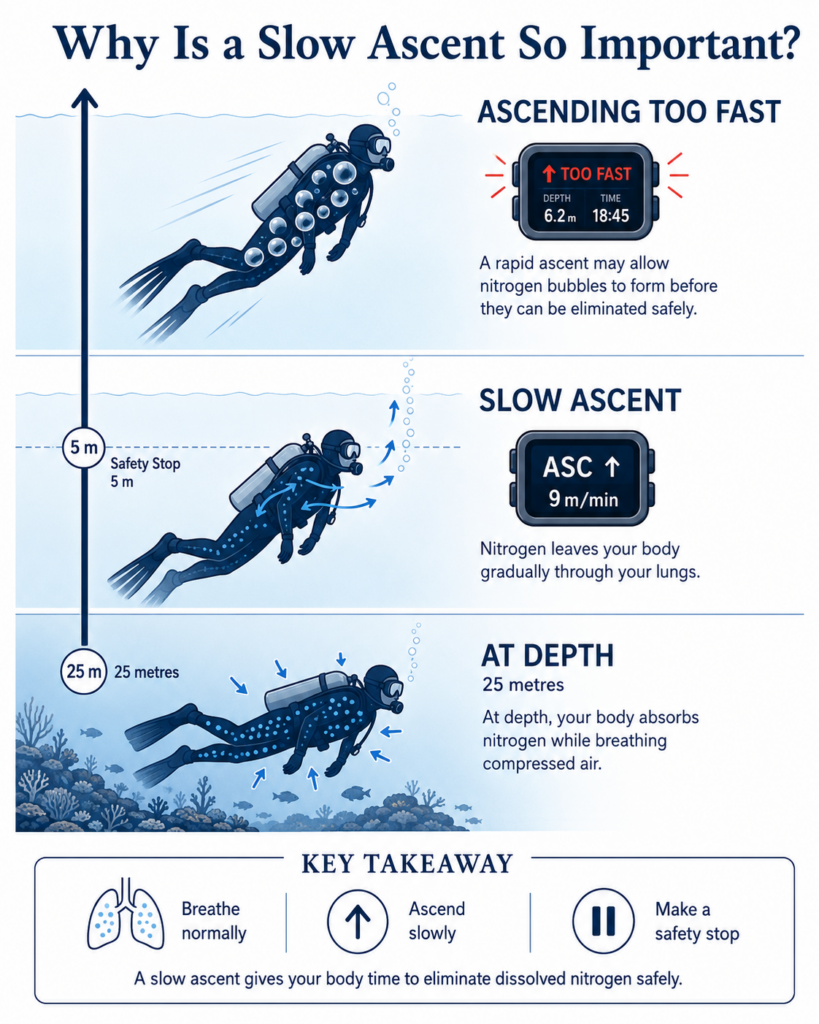
During a dive, your body absorbs nitrogen from the breathing gas. A slow ascent gives your body time to release that dissolved nitrogen safely through your lungs. Ascending too quickly increases the risk of decompression sickness and other pressure-related injuries.
What Happens to Your Body Underwater?
When you breathe compressed air underwater, your body absorbs nitrogen.
The deeper you dive and the longer you stay underwater, the more nitrogen dissolves into your body’s tissues.
This is completely normal.
In fact, every recreational dive involves nitrogen absorption.
The important part comes during the ascent.
Why Can’t the Nitrogen Leave Immediately?
As you ascend, the surrounding pressure decreases.
Your body now needs to eliminate the excess nitrogen.
Fortunately, it has a very efficient way of doing this:
You simply breathe it out.
However, this process isn’t instantaneous.
Nitrogen needs time to move from your tissues into your bloodstream, travel to your lungs and be exhaled.
If you ascend too quickly, your body may not have enough time to eliminate it safely.
Think of It Like Opening a Soda Bottle
Imagine opening a bottle of carbonated soda.
If you open it slowly, the gas escapes gently.
Shake the bottle and open it suddenly, and bubbles form everywhere.
Nitrogen behaves in a similar way inside your body.
A slow ascent allows dissolved gas to leave gradually.
A rapid ascent increases the chance of bubbles forming inside your tissues and bloodstream.
That’s exactly what divers want to avoid.
A slow ascent is one of the simplest yet most important safety habits in scuba diving.
What Happens If You Ascend Too Quickly?
A rapid ascent doesn’t automatically mean you’ll develop decompression sickness.
However, it significantly increases the risk.
If nitrogen leaves your tissues faster than your body can eliminate it through your lungs, bubbles may begin to form inside your body.
These bubbles can affect:
- Joints
- Muscles
- Skin
- Nervous system
- Lungs
The symptoms can range from mild discomfort to serious medical emergencies.
Fortunately, recreational divers can greatly reduce this risk simply by respecting recommended ascent rates.
What Is a Safety Stop?
If you’ve completed your Open Water course, you’ve probably heard your instructor say:
“Let’s make a safety stop.”
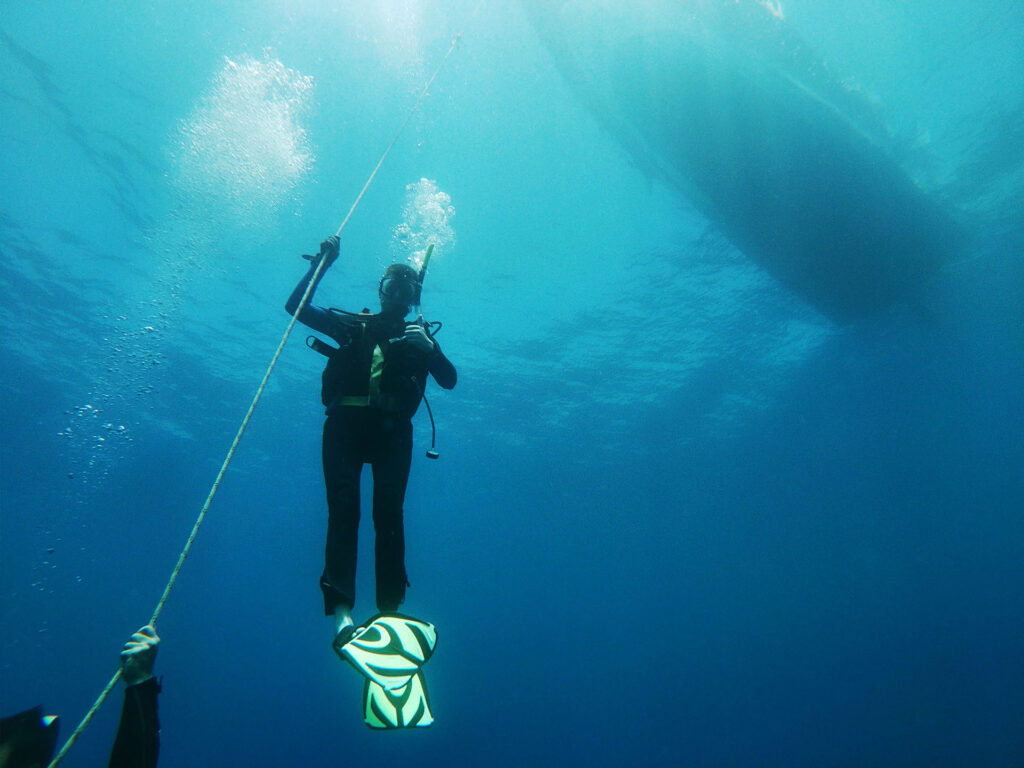
A safety stop is a voluntary pause, typically performed at 5 metres (15 feet) for 3 minutes before surfacing.
Although it isn’t mandatory on every recreational dive, it’s considered good diving practice because it provides additional time for your body to eliminate dissolved nitrogen.
Think of it as giving your body one final opportunity to adapt before returning to surface pressure.
Did You Know?
Even on relatively shallow dives, performing a safety stop is considered good diving practice whenever conditions allow. It’s a simple habit that adds an extra margin of safety.
Why Does My Dive Computer Warn Me?
Many dive computers will sound an alarm if you ascend too quickly.
This isn’t because you’ve immediately put yourself in danger.
It’s because your computer is continuously calculating how your body absorbs and releases nitrogen.
If your ascent rate exceeds the recommended limit, the computer warns you to slow down and return to a safer ascent speed.
Treat these warnings as helpful reminders—not as something to ignore.
How Fast Should You Ascend?
Modern training agencies recommend a controlled ascent, generally no faster than 9–10 metres (30 feet) per minute.
Your dive computer will usually display your ascent rate, making it easy to stay within safe limits.
Remember:
The last few metres of the ascent are the most important.
This is where the pressure changes proportionally the most, so maintaining a slow, controlled ascent becomes even more critical.
Nitrogen needs time to move from your tissues into your bloodstream, travel to your lungs and be exhaled.
Practical Tips for a Safe Ascent
Before every ascent, remember these simple habits:
- Check that your buddy is ready.
- Look above you for boats or other divers.
- Ascend slowly while monitoring your dive computer.
- Breathe normally throughout the ascent.
- Make a safety stop whenever conditions allow.
- Surface calmly and establish positive buoyancy immediately.
A safe ascent should feel controlled—not rushed.
Final Thoughts
Many divers think the dive ends when they leave the bottom.
In reality, the dive isn’t over until you’re safely back at the surface.
A slow ascent is one of the simplest yet most important safety habits in scuba diving.
It allows your body to release nitrogen gradually, helps reduce the risk of pressure-related injuries and gives you time to enjoy the final moments of every dive.
Remember:
The best dives don’t end quickly.
They end safely.