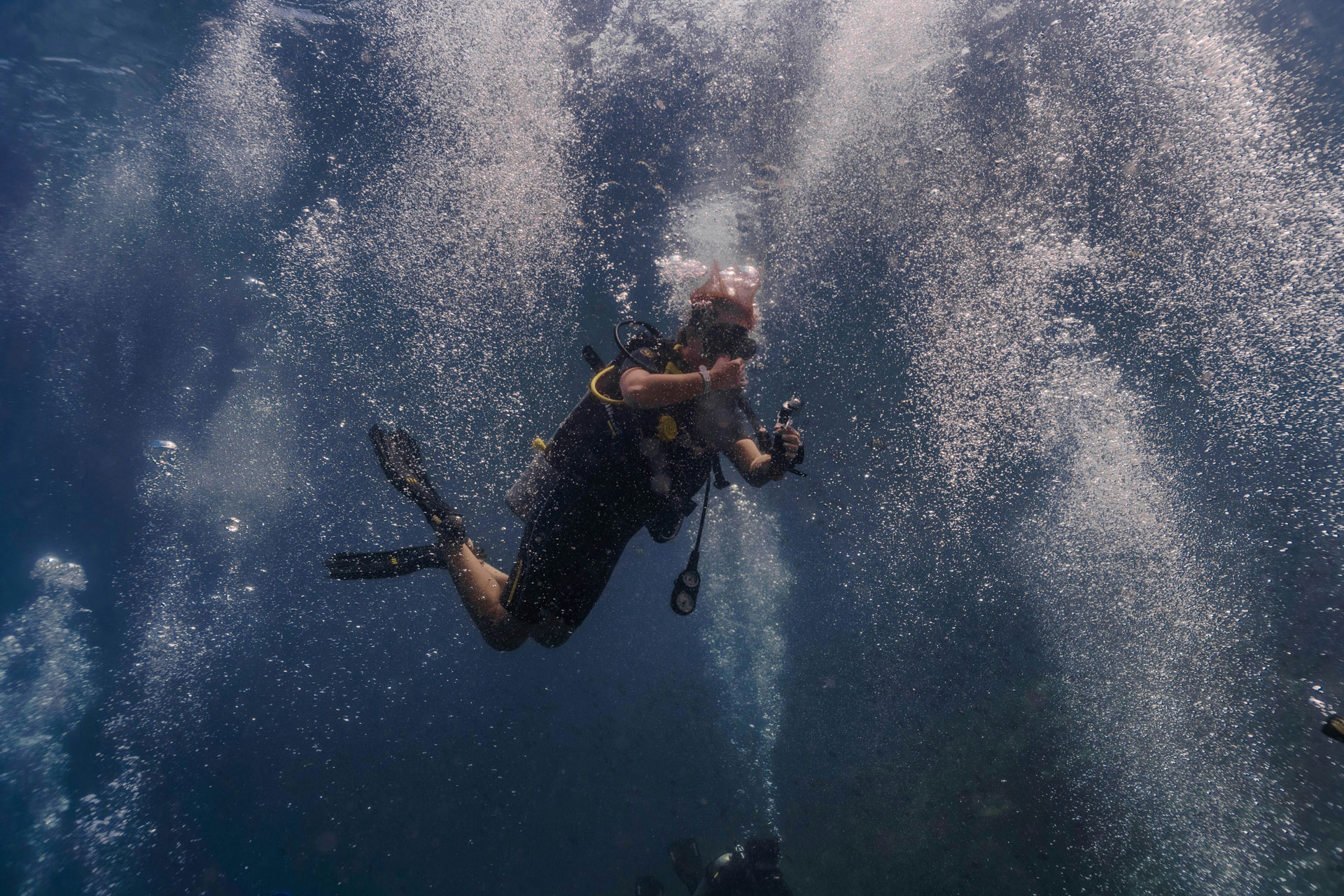
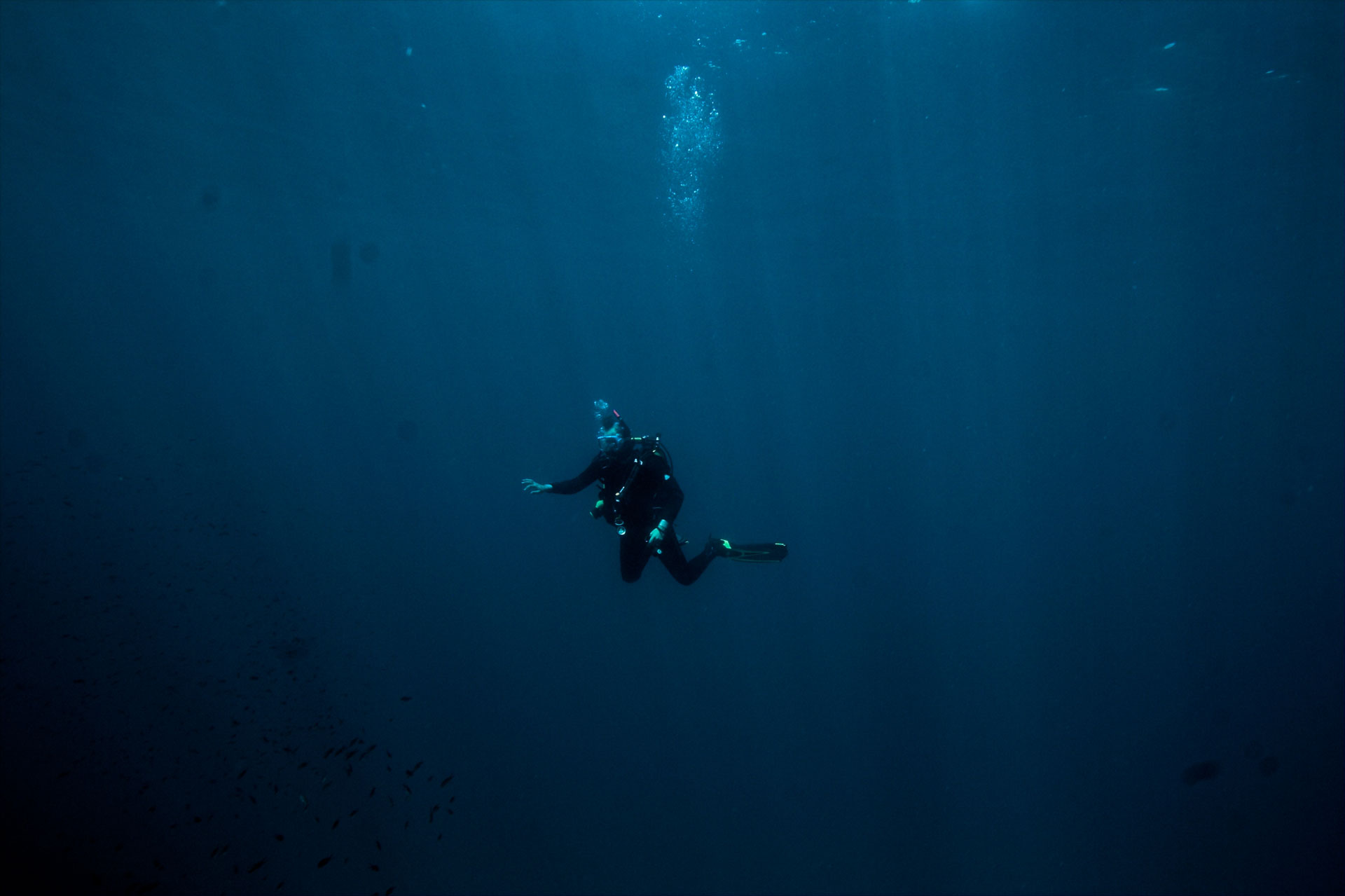
One moment your dive buddy is swimming beside you.
A few seconds later, you turn around—and they’re gone.
Buddy separation can happen more easily than many divers expect. Poor visibility, current, distractions, underwater photography or simply swimming at different speeds can quickly separate two divers.
The important thing is not to panic or begin swimming around without a plan.
Both divers should already know exactly what to do.
Quick Answer
What should you do if you lose your dive buddy underwater?
Stop, remain calm and search the immediate area carefully for approximately one minute. Look around you, above and below, and check for bubbles or light signals. If you cannot find your buddy, make a normal, controlled ascent and reunite at the surface.
Never continue the dive alone.
Lost Buddy Procedure
Stop, look around carefully and search the immediate area for approximately one minute. If you cannot find your buddy, make a normal, controlled ascent and reunite at the surface.
Common Mistake
Many divers immediately swim back in the direction where they last saw their buddy.
The problem is that their buddy may also be moving around looking for them.
Instead of reuniting, both divers can end up moving farther apart. A brief, controlled search from roughly the same location is usually more effective than swimming around without a clear plan.
Why Do Divers Become Separated?
Buddy separation is not always caused by carelessness.
It can happen because of:
- Reduced underwater visibility.
- Strong or changing currents.
- One diver swimming faster than the other.
- A diver stopping to look at marine life.
- Underwater photography or video.
- Poor communication.
- Different depth choices.
- Entering narrow areas or swimming around obstacles.
- Failing to check on each other regularly.
Even experienced divers can become separated.
The difference is that a prepared buddy team has already discussed what to do before entering the water.
Step 1: Stop and Stay Calm
Your first reaction may be to start swimming quickly in the direction where you last saw your buddy.
Don’t rush.
Stop, establish neutral buoyancy and take a moment to think. Try to remember:
- Where you last saw your buddy.
- Which direction they were swimming.
- Whether they were above or below you.
- Whether they had stopped to look at something.
- The direction the dive was supposed to follow.
Staying calm reduces unnecessary movement and air consumption. It also allows you to search more carefully.
If you are struggling to remain stable while searching, avoid constant finning and large BCD adjustments. Establish control first and then begin looking around.
Step 2: Look in Every Direction
The underwater environment is three-dimensional.
Your buddy may not be directly in front of you. They could be above, below, behind or on the other side of a reef formation.
Turn slowly and look carefully:
- In the direction you were travelling.
- Back toward your previous position.
- Above and below you.
- Behind nearby rocks or reef formations.
- Toward any visible streams of bubbles.
- For torch signals in darker conditions.
Your buddy may have stopped only a few metres away and could be hidden by part of the reef, a wreck structure or another group of divers.
Avoid rushing into restricted spaces or entering wrecks, caves or other overhead environments while searching.
Never place yourself in additional danger.
Did You Know?
Scuba divers dressed almost entirely in black can be surprisingly difficult to see underwater, especially in low visibility. Bright equipment details, tank lights and correctly used dive torches can make buddy contact easier.
Step 3: Search Briefly—Not Indefinitely
A commonly taught recreational-diving procedure is to search for your buddy for approximately one minute.
This does not mean racing around as far as possible for 60 seconds.
It means making a slow, deliberate search of the immediate area while remaining aware of your:
- Depth.
- Air supply.
- Buoyancy.
- Surroundings.
- Dive computer.
- Remaining no-decompression time.
Why should the search be brief?
Because your buddy should be following the same procedure.
If both divers search briefly and then ascend, they have a clear location where they can reunite: the surface.
If one diver continues searching underwater while the other surfaces, the separation becomes more difficult to resolve.
DAN describes searching for approximately one minute and then surfacing as a procedure taught during entry-level recreational-diver training. Divers should nevertheless follow the guidance of their own training organisation and the procedure agreed during the dive briefing.
Important
The one-minute search is a commonly taught recreational diving procedure. Always follow the guidance of your training organisation and the lost buddy procedure agreed upon during the dive briefing.
Step 4: Make a Controlled Ascent
If you cannot locate your buddy after the brief search, begin a normal, controlled ascent.
A missing buddy is not a reason to make a dangerously fast ascent.
Monitor:
- Your ascent rate.
- Your depth.
- Your dive computer.
- Your air supply.
- Your surroundings.
- Any boats or other hazards above you.
If you are carrying a DSMB and have been trained to deploy it, use it when appropriate to make your position visible to the surface team.
Complete the ascent according to your training, dive profile and dive computer instructions. Never ignore a mandatory decompression obligation.
During a recreational no-decompression dive, follow your training organisation’s lost-buddy procedure, including its guidance regarding an appropriate safety stop.
A controlled ascent remains essential even when you are worried about your buddy. Our guide Why Is a Slow Ascent So Important in Scuba Diving? explains why your body needs time to adapt to the reduction in pressure.
Common Mistake
Some divers assume they should rush directly to the surface because their buddy may already be there.
A rapid ascent can turn a manageable separation into a second diving emergency.
Your buddy should know the procedure and should also be making a controlled ascent. Stay calm and follow your training.
Step 5: Establish Positive Buoyancy at the Surface
Once you reach the surface, inflate your BCD and establish positive buoyancy.
Look around for your buddy and signal the boat, shore team or divemaster if necessary.
Surface signalling equipment can make an enormous difference, especially during boat dives, drift dives or dives with poor visibility.
Every diver should consider carrying:
- A surface marker buoy or DSMB.
- A whistle.
- A visible signalling device.
- A dive light when appropriate.
A separated diver may surface some distance from the boat or planned exit point. Being visible and able to attract attention is essential.
Safety Tip
A surface marker buoy, whistle and dive light can make a separated diver much easier to locate—especially during boat dives, drift dives or dives with reduced visibility.
What If Your Buddy Does Not Surface?
If your buddy does not appear at the surface, alert the dive leader, boat crew or surface support immediately.
Provide clear information about:
- Where you last saw your buddy.
- At what depth you became separated.
- The direction you were travelling.
- How much time has passed.
- Your buddy’s remaining gas, if known.
- Any relevant current or visibility conditions.
- The equipment your buddy is using.
- The colour of their suit, fins or tank.
Do not descend alone to begin an improvised search.
An underwater search should be organised by appropriately trained people following the dive site’s emergency procedures. An unplanned solo descent could create a second missing diver or another emergency.
If you are diving from a boat, the crew should be informed as quickly as possible so they can begin the established missing-diver procedure and contact emergency services when required.
Should You Continue the Dive After Reuniting?
Reuniting at the surface does not automatically mean that the dive must end.
Before descending again, both divers should pause and reassess the situation together.
Consider:
- How much air each diver has remaining.
- How much dive time has already passed.
- The current no-decompression limits.
- The team’s position relative to the planned route and exit.
- The reason the separation occurred.
- Whether both divers feel calm and comfortable.
- Whether the conditions have changed.
- Whether another separation can reasonably be prevented.
If both divers have sufficient air, remain well within the limits of the dive plan, understand what caused the separation and feel comfortable continuing, the dive may continue with an adjusted plan.
Before descending again, agree on who will lead, how close you will remain and how you will prevent the same situation from happening again.
However, the dive should be ended if either diver feels stressed or uncomfortable, air reserves are no longer sufficient, conditions have deteriorated or the reason for the separation has not been resolved.
The decision should not be automatic.
It should be based on a calm and honest reassessment of the situation.
How Can You Prevent Buddy Separation?
Prevention begins during the dive briefing.
Before entering the water, agree on:
- Who will lead and who will follow.
- Where each diver will normally position themselves.
- How often you will check on each other.
- The planned route and maximum depth.
- Turn pressure and minimum gas reserves.
- Communication signals.
- What to do if visibility decreases.
- The lost buddy procedure.
- Where you will reunite at the surface.
During the dive, remain close enough to communicate and provide assistance.
The appropriate distance depends on visibility, current and the environment. However, if you cannot reach your buddy quickly during an emergency, you are probably too far apart.
Check on your buddy regularly rather than assuming they are still behind you.
Be Extra Careful in Low Visibility
Low visibility makes regular buddy contact even more important.
Stay closer together, reduce your swimming speed and agree on how you will communicate if visual contact becomes difficult.
Dive lights can help, even during daylight dives, but both divers should understand the signals being used.
If visibility becomes worse than expected, consider changing the dive plan or ending the dive. There is no reason to continue if the conditions make it difficult for the team to remain together.
Underwater Photography and Buddy Separation
Underwater photography is a common cause of buddy separation.
A photographer may stop without signalling while the other diver continues swimming. The photographer can also become so focused on the subject or camera settings that they lose awareness of the rest of the team.
If one diver wants to stop for a photograph, communicate first.
The buddy should know:
- That the photographer is stopping.
- Where the photographer is positioned.
- Whether the team is stopping or continuing.
- Who is responsible for navigation and monitoring the surroundings.
A camera should never become more important than maintaining contact with the team.
Lost Buddy Procedure: Quick Checklist
If you lose your dive buddy underwater:
- Stop and stay calm.
- Establish neutral buoyancy.
- Look around, above and below.
- Check for bubbles and light signals.
- Search the immediate area for approximately one minute.
- Make a normal, controlled ascent.
- Follow your computer and training requirements.
- Establish positive buoyancy at the surface.
- Signal the boat or dive team if necessary.
- Do not continue the dive alone.
- Alert surface support immediately if your buddy does not appear.
Final Thoughts
Losing your dive buddy can feel alarming, but the correct response should remain simple:
Stop. Look carefully. Search briefly. Ascend safely. Reunite at the surface.
The procedure works only when both divers understand it.
That is why every buddy team should discuss separation before the dive—even when conditions appear easy and even when they have dived together many times before.
The goal of the buddy system is not simply to enter the water together.
It is to remain a team throughout the entire dive.